
Queue Data Structure: Operations, Types, Code, Applications
A queue stores elements first in, first out. Learn enqueue, dequeue and peek, time complexity, the four types of queue, JavaScript, Python and linked list code, and how a queue differs from a stack.


What is Queue Data Structure?
A queue is a linear data structure that stores elements in an ordered sequence. It is an abstract data type, similar to a stack, but with a different rule: a queue serves the oldest element first, while a stack serves the newest first.
We insert data at one end of the queue, the rear, and remove data from the other end, the front.
Think of a queue at the cinema theatre counter. The person standing first in the queue gets the ticket and leaves the group, while a new person joins at the back end of the queue.
This is at the center of the working of a queue, known as the First In First Out (FIFO) principle.
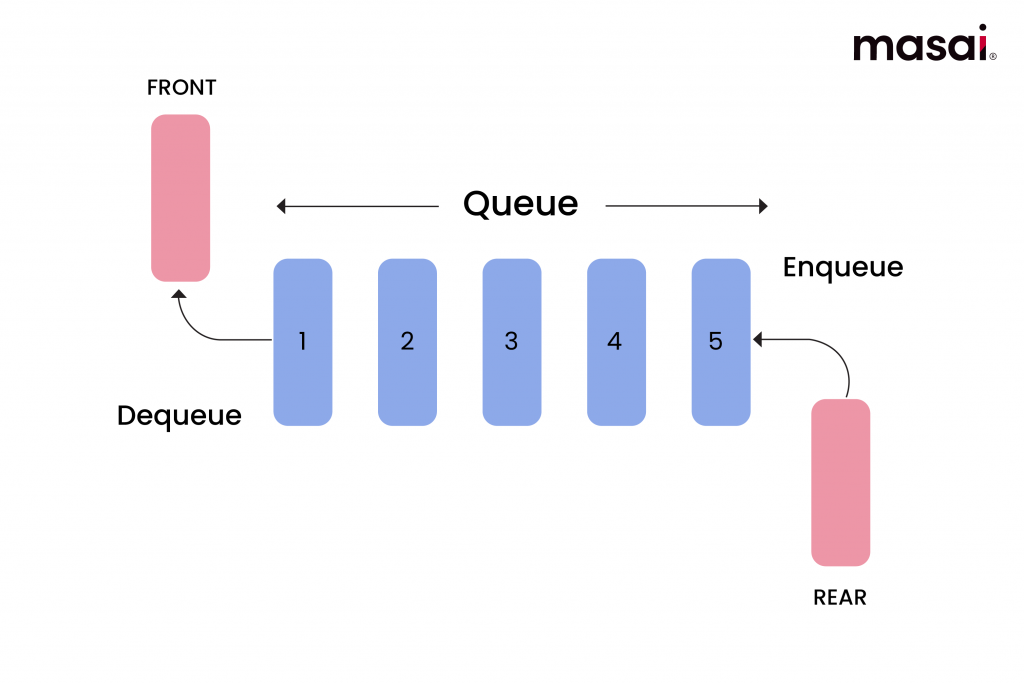
New to data structures? Our beginner's guide to data structures and algorithms covers the basics, and the array guide helps too, because we build the queue on top of an array below.
Basic Operations of a Queue
We can perform the following operations on a queue:
| Operation | What it does | Time |
|---|---|---|
| enqueue(x) | Adds x at the rear of the queue | O(1) |
| dequeue() | Removes the element at the front and returns it | O(1) |
| peek() or front() | Returns the front element without removing it | O(1) |
| isEmpty() | Checks whether the queue has no elements | O(1) |
| isFull() | Checks whether a fixed-size queue has no room left | O(1) |
| size() | Returns the number of elements | O(1) |
The times assume the implementations further down this page. A queue needs two positions: the front pointer is used to peek at and dequeue an element, and the rear pointer marks where the next element is added. Adding to a full queue is called overflow, and removing from an empty queue is called underflow (Wikipedia: queue).
How does Queue work?
Here's how a queue's operations work when the queue is stored in an array:
- The front pointer points to the first element of the queue
- The rear pointer points to the last element
- In an empty queue, we set the values of front and rear to -1.
Enqueue Operation
- Check if the queue is full
- If the queue is empty, set front to 0
- Increase rear by 1
- Add the new element where rear is pointing.
Dequeue Operation
- Check if the queue is empty
- Return the element that is in the front position
- Increase front by 1. Rear stays the same.
We can keep dequeuing one element at a time. When the last element is removed, we reset both pointers to -1, which makes the queue empty again.
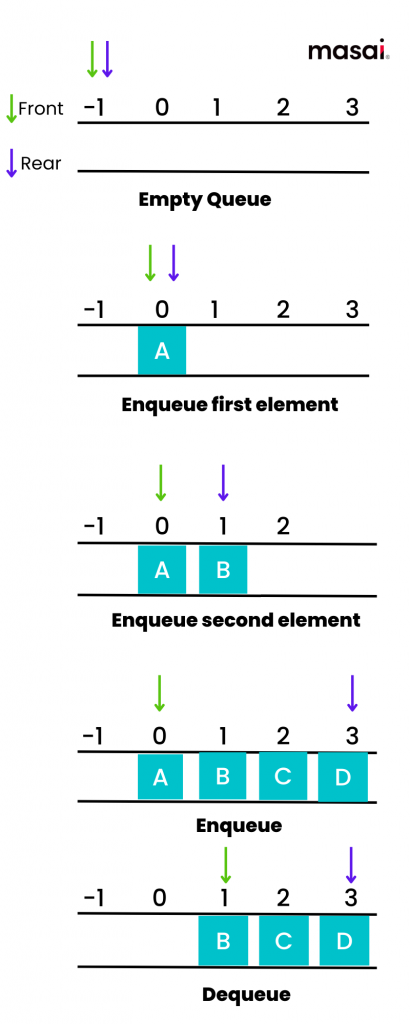
The diagram follows a queue with room for four elements. Here are the same steps in a table:
| Step | Operation | front | rear | Queue, front to rear |
|---|---|---|---|---|
| 1 | start | -1 | -1 | empty |
| 2 | enqueue(A) | 0 | 0 | A |
| 3 | enqueue(B) | 0 | 1 | A, B |
| 4 | enqueue(C), enqueue(D) | 0 | 3 | A, B, C, D |
| 5 | dequeue() returns A | 1 | 3 | B, C, D |
Time complexity of queue operations
How fast a queue is depends on how you build it. Enqueue and peek are cheap in every version. Dequeue is the one that changes: removing the first element of a plain array moves every other element, which makes it O(n).
| Operation | Circular array or array with a head index | Linked list with a tail pointer | Array with shift() |
|---|---|---|---|
| enqueue | O(1), amortized if the array grows | O(1) | O(1), amortized |
| dequeue | O(1) | O(1) | O(n) |
| peek | O(1) | O(1) | O(1) |
| isEmpty, size | O(1) | O(1) | O(1) |
| search for a value | O(n) | O(n) | O(n) |
MDN describes shift() as moving all the remaining values one place to the left, which is where the O(n) comes from. The Python documentation makes the same point for lists: pop(0) costs O(n) because the other elements have to move, while a collections.deque adds and removes at either end in O(1). Space is O(n) for n stored elements.
Implementation of Queue Data Structure
We can implement a queue in the following ways:
- Sequential allocation: the queue is stored in an array. With a fixed-size array the queue can hold only a limited number of elements. A dynamic array, such as a JavaScript array, grows as needed.
- Linked list allocation: each element is a node that points to the next one. A queue built on a linked list grows one node at a time, so it has no fixed limit other than the available memory.
Queue with front and rear pointers
This is the array version from the diagram above, written in JavaScript. Front and rear start at -1, the first enqueue moves front to 0, and every enqueue moves rear one place to the right.
class ArrayQueue {
  constructor(capacity) {
    this.data = new Array(capacity);
    this.front = -1;                     // -1 means the queue is empty
    this.rear = -1;
  }

  isEmpty() {
    return this.front === -1;
  }

  isFull() {
    return this.rear === this.data.length - 1;
  }

  enqueue(value) {
    if (this.isFull()) throw new Error('Queue overflow');
    if (this.isEmpty()) this.front = 0;  // first element: front moves from -1 to 0
    this.rear++;
    this.data[this.rear] = value;
  }

  dequeue() {
    if (this.isEmpty()) throw new Error('Queue underflow');
    const value = this.data[this.front];
    if (this.front === this.rear) {
      this.front = -1;                   // that was the last element: reset both pointers
      this.rear = -1;
    } else {
      this.front++;
    }
    return value;
  }

  peek() {
    if (this.isEmpty()) throw new Error('Queue is empty');
    return this.data[this.front];
  }
}

const q = new ArrayQueue(4);
console.log(q.front, q.rear);               // -1 -1   (empty queue)
q.enqueue('A');
console.log(q.front, q.rear);               // 0 0
q.enqueue('B');
console.log(q.front, q.rear);               // 0 1
q.enqueue('C');
q.enqueue('D');
console.log(q.front, q.rear, q.isFull());   // 0 3 true
console.log(q.dequeue());                   // A
console.log(q.front, q.rear, q.peek());     // 1 3 B
try {
  q.enqueue('E');                           // slot 0 is free, but rear is already at the last index
} catch (e) {
  console.log(e.message);                   // Queue overflow
}
The last lines show the weak spot. After one dequeue there is a free slot at index 0, but rear is already at the last index, so the queue reports overflow. A circular queue, described under the types of queue below, fixes this.
JavaScript program to implement a queue using an array
In everyday JavaScript you do not need fixed pointers. An array already grows, and push() adds at the rear while shift() removes from the front. Here is a queue class built on that:
class Queue {
  constructor() {
    this.items = [];
  }

  // add an element at the rear
  enqueue(element) {
    this.items.push(element);
  }

  // remove and return the element at the front
  dequeue() {
    if (this.isEmpty()) return undefined;
    return this.items.shift();
  }

  // view the front element without removing it
  peek() {
    return this.items[0];
  }

  // check if the queue is empty
  isEmpty() {
    return this.items.length === 0;
  }

  // the number of elements
  size() {
    return this.items.length;
  }

  // empty the queue
  clear() {
    this.items = [];
  }
}

const queue = new Queue();
queue.enqueue('Asha');
queue.enqueue('Ravi');
queue.enqueue('Meera');
console.log(queue.peek());      // Asha
console.log(queue.dequeue());   // Asha
console.log(queue.dequeue());   // Ravi
console.log(queue.size());      // 1
console.log(queue.isEmpty());   // false
This is the easiest version to read, but shift() moves every remaining element, so dequeue is O(n). For a long queue, keep a head index and never shift:
class FastQueue {
  constructor() {
    this.items = {};     // maps an index to its element
    this.head = 0;       // index of the front element
    this.tail = 0;       // index where the next element will be stored
  }

  enqueue(element) {
    this.items[this.tail] = element;
    this.tail++;
  }

  dequeue() {
    if (this.isEmpty()) return undefined;
    const element = this.items[this.head];
    delete this.items[this.head];        // no other element has to move
    this.head++;
    return element;
  }

  peek() {
    return this.items[this.head];
  }

  isEmpty() {
    return this.tail === this.head;
  }

  size() {
    return this.tail - this.head;
  }
}

const queue = new FastQueue();
queue.enqueue('Asha');
queue.enqueue('Ravi');
queue.enqueue('Meera');
console.log(queue.dequeue());   // Asha
console.log(queue.peek());      // Ravi
console.log(queue.size());      // 2
Queue using a linked list
With a linked list you keep two pointers: head at the front and tail at the rear. Enqueue links a new node after the tail and dequeue moves the head forward, so both are O(1) and nothing is ever shifted.
class QueueNode {
  constructor(value) {
    this.value = value;
    this.next = null;
  }
}

class LinkedQueue {
  constructor() {
    this.head = null;                     // front of the queue
    this.tail = null;                     // rear of the queue
    this.length = 0;
  }

  enqueue(value) {
    const node = new QueueNode(value);
    if (this.tail) this.tail.next = node; // link the old rear to the new node
    else this.head = node;                // the first element is both front and rear
    this.tail = node;
    this.length++;
  }

  dequeue() {
    if (!this.head) return undefined;     // underflow
    const value = this.head.value;
    this.head = this.head.next;
    if (!this.head) this.tail = null;     // the queue just became empty
    this.length--;
    return value;
  }

  peek() {
    return this.head ? this.head.value : undefined;
  }
}

const q = new LinkedQueue();
q.enqueue('A');
q.enqueue('B');
q.enqueue('C');
console.log(q.dequeue(), q.peek(), q.length);   // A B 2
Queue in Python and Java
Most languages ship a ready-made queue, so in real projects you rarely write your own.
| Language | Built-in option | Enqueue | Dequeue | Peek |
|---|---|---|---|---|
| Python | collections.deque | append(x) | popleft() | d[0] |
| Java | Queue interface (ArrayDeque, LinkedList) | offer(x) or add(x) | poll() or remove() | peek() or element() |
In Java's Queue interface, offer, poll and peek return false or null instead of throwing an exception, while add, remove and element throw one. In JavaScript you build the queue from an array or a linked list, as above. A Python queue takes three lines:
from collections import deque

queue = deque()
queue.append('A')             # enqueue at the rear
queue.append('B')
queue.append('C')
print(queue.popleft())        # dequeue from the front: A
print(queue[0])               # peek at the front: B
print(len(queue), len(queue) == 0)   # size and isEmpty: 2 False
Types of Queue
Following are the different types of queues:
Simple Queue
It's the basic queue in which insertion happens at the rear end and deletion happens at the front end of the queue. Every example above is a simple queue.
Circular Queue
In a circular queue the last position is connected back to the first, so the array is treated as a circle. It follows the FIFO principle and is also known as a ring buffer. When the rear reaches the end of the array it wraps around to index 0 if that slot is free, so no space is wasted. The next position is always (index + 1) % capacity.
The class below keeps a count of the stored elements. That makes it easy to tell a full queue from an empty one, because when the front and rear positions meet, the queue could be either (Wikipedia: circular buffer).
class CircularQueue {
  constructor(capacity) {
    this.data = new Array(capacity);
    this.front = 0;                    // index of the oldest element
    this.count = 0;                    // how many elements are stored
  }

  isEmpty() {
    return this.count === 0;
  }

  isFull() {
    return this.count === this.data.length;
  }

  enqueue(value) {
    if (this.isFull()) throw new Error('Queue overflow');
    const rear = (this.front + this.count) % this.data.length;   // wraps past the end of the array
    this.data[rear] = value;
    this.count++;
  }

  dequeue() {
    if (this.isEmpty()) throw new Error('Queue underflow');
    const value = this.data[this.front];
    this.data[this.front] = undefined;
    this.front = (this.front + 1) % this.data.length;
    this.count--;
    return value;
  }
}

const q = new CircularQueue(4);
for (const letter of ['A', 'B', 'C', 'D']) q.enqueue(letter);
console.log(q.dequeue());     // A
q.enqueue('E');               // reuses the free slot at index 0
console.log(q.data);          // [ 'E', 'B', 'C', 'D' ]
console.log(q.isFull());      // true
Compare this with the front-and-rear version earlier: there, enqueuing E after one dequeue failed with overflow, and here it reuses the freed slot. Circular queues are used as ring buffers that hold data streams, and for round-robin CPU scheduling, where processes take turns in a repeating order.
Priority Queue
In a priority queue every element has a priority, and the element with the highest priority is removed first, not the oldest one. Whether “highest” means the smallest or the largest number is a convention: Java's PriorityQueue treats the lowest value as the highest priority, and so does Python's heapq. If two elements have the same priority, the order between them is not guaranteed unless you add a tie-breaker, such as an arrival counter.
A binary heap is the usual implementation. Inserting an element and removing the top one are both O(log n), and reading the top element is O(1) (Wikipedia: priority queue).
import heapq

tasks = []
heapq.heappush(tasks, (2, 'write report'))
heapq.heappush(tasks, (1, 'fix login bug'))
heapq.heappush(tasks, (3, 'update docs'))

while tasks:
    priority, task = heapq.heappop(tasks)   # the smallest number comes out first
    print(priority, task)

# Output:
# 1 fix login bug
# 2 write report
# 3 update docs
A few primary use cases for a priority queue are Dijkstra's shortest path algorithm, Prim's algorithm and Huffman coding for data compression. Routers also use priority queues to send high-priority traffic first.
Double-ended Queue
As the name suggests, a double-ended queue (deque, pronounced “deck”) allows both insertion and deletion at both ends. In other words, we can add elements at the rear and the front, and remove them from either end.
A deque generalizes both structures: used at one end only it behaves like a stack, and used at opposite ends it behaves like a queue. There are also two restricted forms. An input-restricted deque allows insertion at one end only, and an output-restricted deque allows removal at one end only.
from collections import deque

d = deque()
d.append('B')           # add at the rear
d.appendleft('A')       # add at the front
d.append('C')
print(d)                # deque(['A', 'B', 'C'])
print(d.popleft())      # A  (remove from the front)
print(d.pop())          # C  (remove from the rear)
A well-known use of a deque is work stealing: each processor takes tasks from one end of its own deque, and other processors steal tasks from the opposite end. A deque also gives a linear-time solution to the sliding-window maximum problem (Wikipedia: double-ended queue).
Types of queue compared
| Type | Which element leaves first | Typical use |
|---|---|---|
| Simple queue | The oldest element | Printer spooling, first-come-first-served scheduling, breadth-first search |
| Circular queue | The oldest element, in a fixed-size array that wraps around | Ring buffers, round-robin scheduling |
| Priority queue | The element with the highest priority | Dijkstra's algorithm, Huffman coding, event simulation |
| Double-ended queue | Whichever end you choose | Work stealing, sliding-window maximum, a stack and a queue in one |
Difference between Stack and Queue
Despite both being linear data structures and abstract data types, a stack and a queue have major differences. Let's have a look:
| Basis | Stack | Queue |
|---|---|---|
| Principle | Last In First Out (LIFO) | First In First Out (FIFO) |
| Where elements are inserted and removed | Both at the same end, the top | Inserted at the rear, removed from the front |
| Pointers | One pointer, which points to the top of the stack | Two pointers: front and rear |
| Basic operations | Push and pop | Enqueue and dequeue |
| Shape | A vertical structure | A horizontal structure |
| Everyday example | A pile of books, where you take the top one first | People standing in a line outside the ticket counter |
| Typical uses | Function calls, expression evaluation, backtracking, depth-first search | Scheduling, breadth-first search, buffers |
The stack data structure guide covers the other side in the same way. In graph search the choice is exactly this one: keep the next nodes in a queue and you get breadth-first search, keep them in a stack and you get depth-first search (see the graph data structure guide).
Applications of Queue Data Structure
A queue keeps elements in the order they arrived, so it has many applications wherever work must be served first come, first served, or where a fast producer feeds a slow consumer. This is the short version. Our guide to the applications of queue explains each one with a worked example.
| Application | How the queue is used |
|---|---|
| Job scheduling | A classic application. The operating system keeps the processes that are ready to run in a queue and gives the CPU to them one by one. First come first served runs them in arrival order, and round robin sends each process to the back of the queue after its time slice. |
| Shared resources | Disks, printers and other single shared resources use a queue as a waiting list. A print spooler queues the print jobs and feeds them to the printer one by one. |
| Asynchronous data transfer | A queue sits between a fast producer and a slow consumer, for example keyboard input waiting for the CPU, IO buffers and pipes. |
| Breadth-first search | Nodes waiting to be explored are kept in a queue, so closer nodes are handled before farther ones. On a tree this is level-order traversal. |
| Networks | Routers hold packets in queues, and mail servers keep a mail queue of messages waiting to be delivered. |
| Message queues and background jobs | Web apps put slow work, such as sending an email, in a queue and let workers process it in order. |
| Traffic lights | A traffic-light controller cycles through its phases in a fixed repeating order, which a circular queue models. |
Classic queue interview problems
Most queue questions are variations of a few ideas:
| Problem | Idea |
|---|---|
| Implement Queue using Stacks | Use two stacks. Push new elements on the first one. To dequeue, if the second stack is empty, pour every element from the first into the second, which reverses their order, then pop from the second. |
| Implement Stack using Queues | After enqueuing a new element, dequeue and re-enqueue all the older elements, so the newest element ends up at the front. |
| Design Circular Queue | Store the elements in a fixed array with a front index and a count, and wrap every index with (i + 1) % capacity, as in the circular queue above. |
| Sliding Window Maximum | Keep a deque of indexes whose values decrease from front to back. The front is always the maximum of the current window, and each index enters and leaves once, so the total time is O(n). |
| Binary Tree Level Order Traversal | Breadth-first search with a queue, processing one whole level at a time. |
Frequently asked questions
What is a queue in data structure?
A queue is a linear data structure that follows First In First Out (FIFO). Elements are added at the rear (enqueue) and removed from the front (dequeue), so the element that has waited longest leaves first, like people in a line at a ticket counter.
What are the basic operations of a queue?
Enqueue adds an element at the rear, dequeue removes the element at the front, peek reads the front element without removing it, isEmpty checks for no elements, isFull checks a fixed-size queue for room, and size returns the count. Enqueue and dequeue take O(1) time in a well-built queue.
What are the types of queue in data structure?
The four types are the simple queue (plain FIFO), the circular queue (a fixed-size queue whose end wraps around to the start), the priority queue (the highest priority leaves first) and the double-ended queue, or deque (insert and remove at both ends).
What are the applications of a queue?
Queues are used for CPU scheduling, breadth-first search, printer spooling, buffers between fast and slow devices, router packet queues and message queues for background jobs. All of them serve items in the order they arrived. The applications of queue guide has worked examples.
What is the difference between a stack and a queue?
A stack is last in, first out and works at one end only, the top. A queue is first in, first out: elements are added at the rear and removed from the front. Use a stack for nested or reversing problems such as function calls, and a queue for work that must be handled in arrival order.
How do you implement a queue in JavaScript?
Use an array: push() adds at the rear and shift() removes from the front. Because shift() moves every remaining element, dequeue is O(n) on long queues. For O(1) dequeue, keep a head index, or use a linked list with head and tail pointers.