
MBA in wealth management vs CFA vs CFP: which one truly advances your career in 2026?

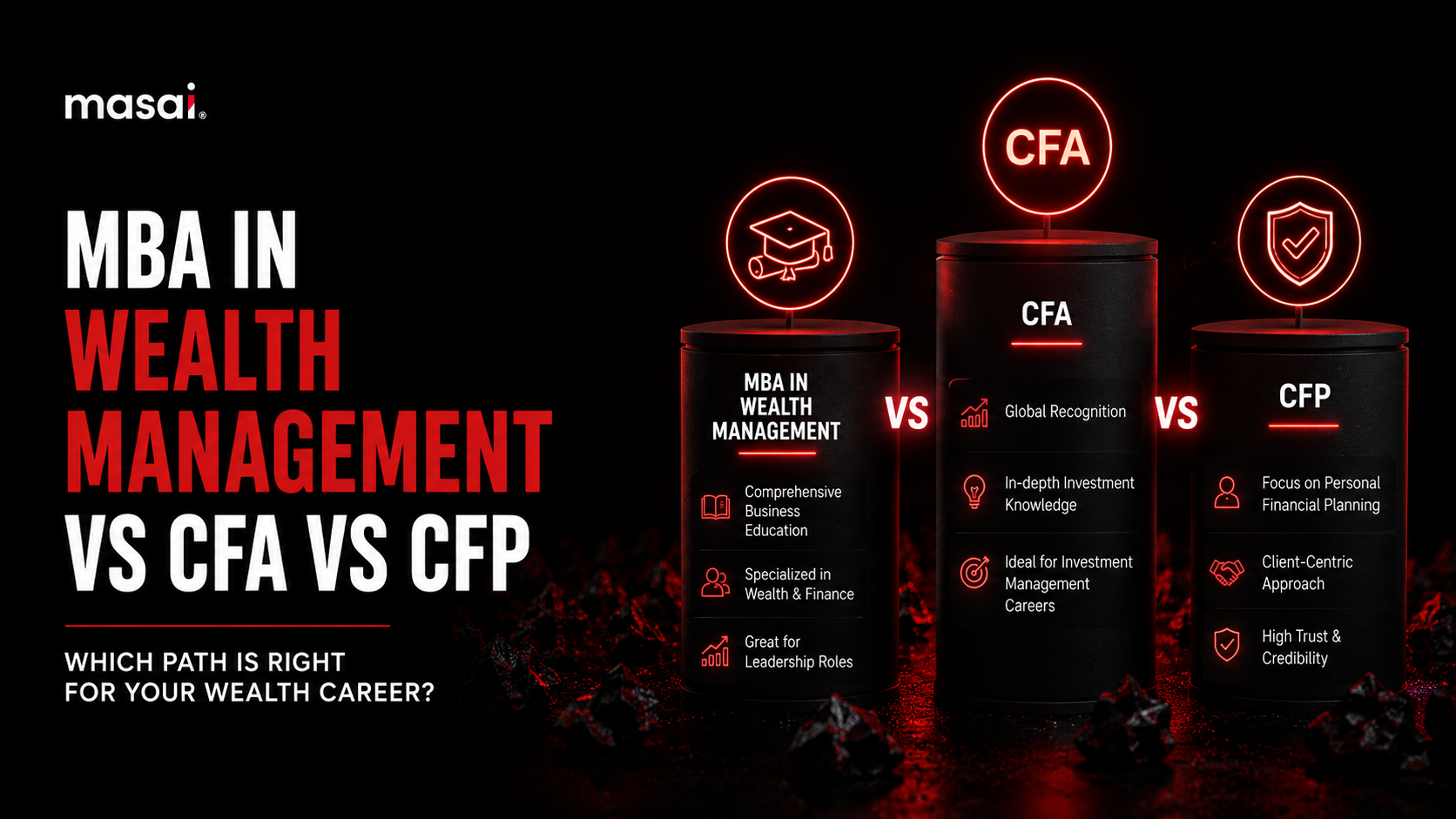
Real talk for finance pros ready to stop second-guessing and start making strategic moves.
When you start researching finance credentials, it feels like every website has an answer, every coaching institute has an opinion, and every suggestion conveniently points to what they’re selling.
Let's cut through the noise.
India’s wealth management market is on fire. According to Deloitte’s January 2025 report, there’s a $1.6 trillion asset growth opportunity between FY24 and FY29. The High Net Worth Individual (HNWI) population has already crossed 850,000 and is expected to nearly double by 2027. Even more striking, India’s Ultra High Net Worth Individuals (UHNI) are projected to grow by 50% by 2028, the fastest pace among major global economies.
This isn’t just a trend, it's a structural transformation.
So here’s the real question every finance professional facing the credential dilemma needs to ask:
Which qualification genuinely equips you to work at this elevated level?
The debate usually boils down to three big names: MBA, CFA, and CFP.
Let’s break it down honestly.
What each credential was originally designed for
Before diving into comparisons, understand the purpose behind each credential. This sets the stage for where they can take your career.
- CFA (Chartered Financial Analyst): Built for investment analysts. It’s globally recognized for deep technical expertise in financial statement analysis, portfolio management, equity research, and corporate finance. If your passion lies in the numbers, spreadsheets, and investment theses, CFA is your go-to.
- CFP (Certified Financial Planner): Created for financial planners focused on client-centered advisory retirement, insurance, taxation, estate planning. If you want to work directly with clients to build life and financial plans, CFP offers the framework.
- MBA in Wealth Management (e.g., IIM Mumbai): Designed to develop finance professionals into leaders. This isn’t just about understanding markets or plans it’s about building practices, managing teams, navigating complex advisory landscapes, and leading institutional and HNI relationships.
That leadership distinction is crucial. Keep it in mind as we move forward.
Comparing the credentials: Different paths, different outcomes
1. IIM Mumbai executive MBA in wealth management
A leadership credential designed for the future of Indian wealth management.
This is a one-year, weekend program at IIM Mumbai ranked 6th by NIRF in 2025 right in the heart of India’s financial capital. Graduates join an elite alumni network with strong ties to the industry.
What sets this MBA apart?
It’s built for the new reality of wealth management, not the past model.
The curriculum covers everything from portfolio management and investment strategy to risk, taxation, estate planning, and behavioral finance. Plus, it includes dedicated modules on AI and machine learning and digital transformation not optional extras, but core subjects.
Why does this matter?
Today’s HNI clients are younger, tech-savvy, and digitally native. About 20% of India’s HNIs are under 40. They demand advisors comfortable with sophisticated tools, alternative assets, and cutting-edge portfolio solutions.
Sticking to traditional advisory methods won’t cut it anymore. The IIM Mumbai MBA prepares you to lead in this tech-driven, evolving landscape.
Additional perks include:
- Two-stage Capstone Project focused on real-world wealth management scenarios.
- Access to IIM Mumbai’s powerful institutional network faculty, alumni, and industry leaders.
- A management framework that grooms you for leadership roles like practice heads, family office directors, or private banking division leaders.
Best for: Experienced finance professionals aiming for senior advisory, leadership, or entrepreneurial roles in wealth management. Those who want to combine deep expertise with institutional credibility and tech fluency.
2. CFA (Chartered Financial Analyst)
The gold standard for investment analysis worldwide.
The CFA is highly respected globally for its rigorous curriculum and technical depth. Passing three challenging levels requires dedication, with pass rates around 40-50% per level.
It’s ideal if you want to be an equity analyst, portfolio manager, or research professional at an institutional investor or asset management firm.
But here’s the catch: CFA doesn’t teach leadership, client management, or business-building skills. It’s a specialist credential focused on investment analysis, not wealth management leadership.
From a practical perspective, CFA demands a significant time investment often 3 to 5 years to complete.
Best for: Professionals targeting roles in investment management, equity research, or portfolio management, who prefer deep technical expertise over leadership training.
3. CFP (Certified Financial Planner)
The go-to credential for client-focused financial planning.
CFP is well-regarded for financial planners working directly with individuals and families on budgeting, insurance, retirement, taxes, and estate planning. It fits well with the emerging independent financial advisor market in India.
However, CFP lacks the institutional weight and leadership training needed for senior wealth management roles. It doesn’t provide the strategic frameworks or networks that matter for managing HNI (High Net Worth Individual) or UHNI (Ultra High Net Worth Individual) clients at private banks, family offices, or wealth firms.
Best for: Independent advisors and planners focusing on retail and mass-affluent clients. A solid foundation but usually insufficient alone for senior wealth advisory careers.
What the Indian wealth management industry needs today
India’s wealth management is shifting rapidly from a product-push, distribution-driven model to a fee-based, fiduciary advisory model.
HNIs are more sophisticated they want advisors who understand alternative assets, cross-border planning, digital portfolio tools, and advanced estate strategies.
Family offices are booming, and wealth is spreading beyond metro hubs to Tier-2 and Tier-3 cities.
Demand for qualified, credible wealth management leaders is soaring but supply isn’t keeping pace.
The future leaders? They’re not just technical experts. They’re strategic thinkers, networked professionals fluent in technology and leadership. This is what the IIM Mumbai MBA in Wealth Management is designed to cultivate.
Quick side-by-side comparison
Which one should you choose?
Go for the IIM Mumbai MBA if: You’re a finance pro aiming for senior wealth management roles and leadership. You want a credential that matches the industry’s fast-evolving landscape, backed by the credibility and network of IIM Mumbai.
Choose CFA if: You want to specialize deeply in investment management and are ready for a long-term, challenging study commitment.
Opt for CFP if: Your goal is financial planning for retail or mass-affluent clients, and you want a practical certification to build that practice.
One more thing worth saying
The finance professionals who will lead India's wealth management industry in 2035 are making credential decisions right now.
The clients they'll be serving younger HNIs, first-generation wealth creators, digital-native investors will expect more than what traditional finance credentials prepare you for. They'll expect advisors who understand AI-driven portfolio tools, alternative asset structures, and sophisticated estate planning. They'll expect advisors who can lead, not just advise.
That's the gap the IIM Mumbai MBA in Wealth Management was built to close. And it's being offered from the campus of one of India's top management institutions, in the city that is the epicentre of everything the industry is becoming.
The IMAT exam is on 31st May 2026. The session begins June 2026. 100 seats.
If you're serious about where your career in wealth management goes next this is worth your full attention.
Explore the IIM Mumbai Executive MBA in Wealth Management →