
Is an Executive MBA from an IIM Worth It? An Honest ROI Breakdown
Quick answer
Is an IIM executive MBA worth it? A practical ROI framework with real costs, hidden costs, break-even maths and who should skip it. No inflated salary claims.

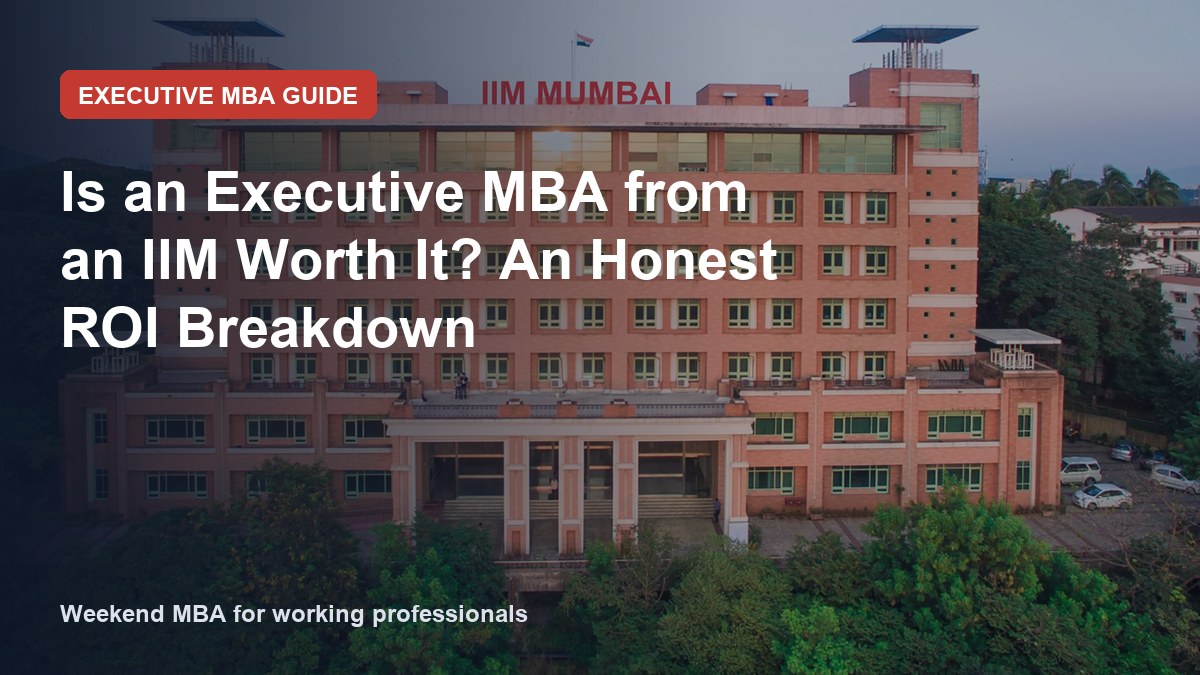
Searching "is an executive MBA worth it" usually returns brochures that say yes. A fair answer is more useful: sometimes it pays off well, sometimes it does not, and the difference lies in your goal and your numbers.
This post gives you a way to test the decision yourself, without borrowing anyone's salary claims.
1. Start with the real price tag
For IIM Mumbai's executive programmes, the official programme page lists these fees, including taxes, as at the time of writing:
- MBA-PGPM (campus, Powai): Rs 18,00,000 on the annual plan, or Rs 19,00,000 module-wise.
- MBA-ePGPM (outreach centres): Rs 14,50,000 on the annual plan, or Rs 15,00,000 module-wise, plus a refundable caution deposit of Rs 50,000.
- Application fee: Rs 3,000, non-refundable.
Fees can be revised, so confirm before applying. The module-wise plans cost Rs 1 lakh (campus) or Rs 50,000 (ePGPM) more in total, which is the price of spreading payments.
2. Add the hidden costs
Tuition is not the whole bill. Add:
- Travel and stay, if you attend at Powai from another city.
- Study material, laptop or internet upgrades.
- Interest, if you borrow.
- Time: two years of Saturdays and Sundays, plus weeknight assignments.
Some banks do lend for part-time executive MBAs. Indian Bank's education loan scheme page, for instance, lists Executive MBA programmes for working professionals under its own terms. Check whether your chosen programme qualifies with the bank you approach.
Time is a real cost. Weekend classes mean fewer family outings, fewer trips home and less rest. Put a value on that honestly.
3. Identify the specific return you want
"Better career" is not a plan. Pick one of these and write it down:
- A promotion to a defined role within your company.
- A function change, such as engineering to operations or product management.
- A jump from team lead to business head.
- Readiness to start or run a business.
- A broader network and credibility with senior colleagues.
An executive MBA suits the first three well, since classwork can be applied at your workplace immediately. It is weaker as a tool for a complete industry switch, because there are no campus recruiters waiting.
4. Run your own break-even maths
Use this simple formula:
Break-even years = (total cost + interest) / extra annual income you can credibly attribute to the programme
As pure arithmetic, a Rs 18 lakh outlay needs about Rs 3 lakh a year of extra pre-tax income to be recovered in six years, before counting interest. The Rs 3 lakh is only an illustration, not a typical outcome.
Be conservative with the denominator. Ask yourself whether the raise would have come anyway and whether your employer has a concrete role waiting. Speak to alumni of the specific programme rather than relying on averages quoted online.
5. What the programme actually teaches
Value comes from content too. IIM Mumbai's programme is 75 credits across 6 modules, with 17 core courses, 8 electives and 3 projects, including an Action Learning Project and a two-part Capstone. Core courses include Corporate Finance, Operations Management, Supply Chain Management, Business Applications of AI and ML, and Strategic Management.
If you already work in operations, supply chain, analytics or industrial management, that mix lines up with IIM Mumbai's known strengths, since the institute (formerly NITIE) has over 60 years of history in industrial management. If your work is far from these areas, check that the electives match your goal.
6. The credential and the network
IIM Mumbai's Management rank in NIRF 2025 is 6, and graduates get IIM Mumbai alumni status. Brand helps with credibility, especially in conservative or large organisations. But a brand opens a door and does not do the interview for you.
The peer group matters just as much. Classmates who are managers across industries become sounding boards, referrers and sometimes future colleagues. This value is real but unquantifiable, so treat it as a bonus, not as the justification.
7. When it is probably not worth it
- You want a guaranteed salary figure before paying.
- The fee would push you into debt that strains your family.
- You cannot commit to 75% attendance. At IIM Mumbai, attendance below that threshold costs grades.
- Your goal could be met with a shorter, cheaper course or a certification.
- You are comparing it with a one-year full-time route, such as IIM Calcutta's residential MBA for Executives, and the real question is whether you can leave your job at all. The two are different bets, so do not compare fees alone.
- You are hoping the credential alone will fix a problem that is really about performance or the wrong employer.
A quick self-check
Answer these before applying:
- What exact role or function do I want in 3 years?
- Does my employer or target employer value this credential?
- Can I pay for it, with or without a loan, without panic?
- Can I protect two years of weekends?
- Have I spoken to at least two alumni?
Four or five clear yeses suggest the programme can be a good investment for you.
Key takeaways
- Worth depends on your goal and your numbers, not on a brochure.
- Count hidden costs: time, travel, interest.
- Use the break-even formula with conservative inputs.
- Do not trust any salary promise that has no source.
- Non-financial returns such as network and alumni status are real but should be weighed separately.
FAQ
Is an executive MBA from an IIM worth the money?
It depends on your goal. It tends to pay off when you have a defined target role, your employer values the credential and the fee is manageable. It is a poor fit if you expect a guaranteed hike.
How long does it take to recover the fees?
There is no universal answer. Divide total cost plus interest by the extra annual income you can realistically attribute to the programme.
What are the hidden costs of an executive MBA?
Application fee, travel, study material, any deposit, loan interest, and the time that weekends and weeknights will no longer give you.
Are there non-financial returns?
Yes: structured management training, a peer network and alumni status. Weigh them separately from the salary maths.
What does IIM Mumbai's MBA-PGPM cost?
As listed on the official page, Rs 18,00,000 for the campus annual plan and Rs 14,50,000 for the MBA-ePGPM annual plan, including taxes. Verify before applying.
Conclusion
An IIM executive MBA is worth it when it is tied to a clear goal, a realistic break-even and a plan to protect your weekends. It is not worth it as a vague investment in "growth". If the maths and the self-check hold up, look at the IIM Mumbai MBA-PGPM programme details for the January 2027 batch, with the IMAT on 22 November 2026. You can also check eligibility and fees here or write to execed@iimmumbai.ac.in.