
IIM Mumbai: History, Rankings and What Makes It Different
Quick answer
IIM Mumbai's story: NITIE founded in 1963, converted to an IIM in 2023, NIRF 2025 management rank 6, Powai campus and its weekend MBA-PGPM.

Many applicants know IIM Mumbai by its new name but not its older one. The institute has a longer history than the "IIM Mumbai" label suggests, and understanding it helps when you compare programmes and read ranking tables.
This post covers the timeline, the ranking, the campus and the programme details that matter if you are a working professional considering the MBA-PGPM.
1. It began as NITIE in 1963
IIM Mumbai was formerly NITIE, the National Institute for Training in Industrial Engineering, established in 1963 in Mumbai. According to Wikipedia's account, the Government of India set it up with help from the United Nations Development Programme, channelled through the International Labour Organization, and it was registered as a society under the Societies Registration Act, 1860. The institute's own programme page describes it as 60-plus years old.
2. It became an IIM in 2023
The Union Cabinet approved the proposal on 12 July 2023. The IIM (Amendment) Bill, 2023 was passed by the Lok Sabha on 4 August and by the Rajya Sabha on 8 August 2023. A Rajya Sabha reply states that NITIE was converted into IIM Mumbai on 16 August 2023 through the Indian Institute of Management (Amendment) Act, 2023 (Act No. 23 of 2023). The same reply notes the institute was not part of any Act of Parliament before this, which had created several challenges.
Different websites quote slightly different dates, because some refer to presidential assent and others to the notified effective date. "August 2023" is the safe way to state it.
3. The ranking: 6th in NIRF 2025 (management)
IIM Mumbai ranked 6th in the NIRF 2025 management category, released by the Ministry of Education on 4 September 2025. Reports say it held the same 6th position the year before. NIRF publishes methodology and category-wise lists on nirfindia.org, so check the official PDF for scores.
A ranking is one input, not a verdict. It does not tell you whether a particular programme's format, fees or curriculum suit your situation.
4. The campus is in Powai
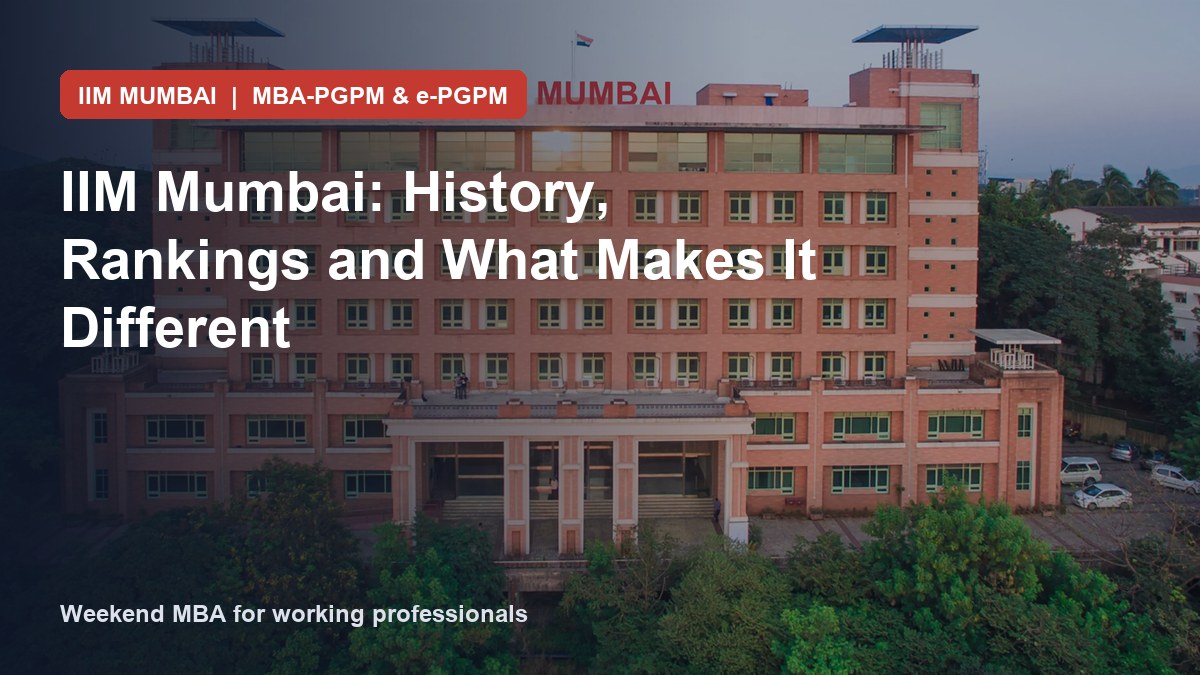
The main campus is in Powai, in Mumbai's north-eastern suburbs, near Vihar Lake, according to Wikipedia, which gives the campus area as about 63.8 acres. The campus MBA-PGPM runs weekend classes here, offline.
5. What it is known for
The executive education page for the MBA-PGPM names operations, supply chain, analytics and industrial management as institutional strengths. That heritage is visible in the curriculum, which includes Operations Management, Supply Chain Management, and Optimisation and Decision Techniques alongside marketing, finance and strategy.
6. The weekend programme in brief
For working professionals, the relevant offerings are:
| Item | Detail (official page) |
|---|---|
| Names | MBA-PGPM (campus, Powai) and MBA-ePGPM (outreach centres) |
| Format | 2 years, Saturday-Sunday |
| Outreach centres | Pune, Chennai, Bengaluru, Hyderabad, Delhi NCR |
| Credits | 75, across 6 modules |
| Courses | 17 core, 8 electives, 3 projects |
| Eligibility | Graduate in any discipline plus at least 2 years of relevant post-graduation work experience |
| Selection | IMAT, or valid CAT, GRE or GMAT, followed by a personal interview |
| Application fee | ₹3,000, non-refundable |
CAT is not compulsory. The home-proctored IMAT is an alternative route.
7. How the curriculum reflects the history
Module 1 covers Marketing Management, Managerial Communication, Financial Reporting and Accounting, Microeconomics, and Optimisation and Decision Techniques. Module 2 adds Operations Management, OB and HRM, Corporate Finance, Macroeconomics and B2B Marketing. Module 3 brings in Business Applications of AI and ML, Sustainable Business Management, Supply Chain Management, Marketing Research and Customer Analytics, and the Action Learning Project. Year 2 centres on strategy, ESG and corporate governance, innovation and entrepreneurship, electives and a two-part Capstone.
Teaching is case-driven, supported by simulations, industry interactions and capstones. Evaluation is 40% continuous, 20% mid-term and 40% module-end, with a 75% attendance minimum.
8. Fees and dates for the current cycle
As listed on the official page (verify before applying), the campus plan is ₹18,00,000 annual or ₹19,00,000 module-wise, including taxes. The ePGPM is ₹14,50,000 annual or ₹15,00,000 module-wise, with a refundable caution deposit of ₹50,000 listed. The IMAT is on 22 November 2026, interviews are on 25 to 27 November, and the batch starts in January 2027.
How to read the history when comparing programmes
The NITIE-to-IIM change is recent, so some people wonder whether the name carries the same recognition as older IIMs. A balanced way to look at it:
- The institution itself is not new. It has operated since 1963 and is described as having 60-plus years of history.
- The IIM status is statutory, created by an Act of Parliament in 2023.
- Rankings give an external reference point, but programme-level fit matters more than a single number.
- Questions about degrees, certificates and alumni structure are best asked directly. Note that campus and outreach-centre students receive different certificates (one for the weekend PGPM, one for the ePGPM), and graduates get IIM Mumbai alumni status.
Ask the programme office (execed@iimmumbai.ac.in) for anything that is not on the public page, such as batch composition or timetable details. This post deliberately avoids placement figures, salary numbers or batch sizes, because none are published on the official page.
Key takeaways
- IIM Mumbai was formerly NITIE, established in 1963 in Mumbai.
- It became an IIM in August 2023 under the IIM (Amendment) Act, 2023.
- It ranked 6th in NIRF 2025 for management.
- Its main campus is in Powai; strengths are operations, supply chain, analytics and industrial management.
- Graduates of the weekend programme receive IIM Mumbai alumni status.
Frequently asked questions
When was IIM Mumbai founded?
IIM Mumbai was formerly NITIE (National Institute for Training in Industrial Engineering), established in 1963. It was converted into an IIM through the IIM (Amendment) Act, 2023, with the change taking effect in August 2023.
What was IIM Mumbai called earlier?
It was called NITIE, the National Institute for Training in Industrial Engineering, based in Mumbai.
What is IIM Mumbai's NIRF ranking?
IIM Mumbai was ranked 6th in the NIRF 2025 management category, the same position it held in 2024.
Where is IIM Mumbai located?
Its main campus is in Powai, in Mumbai's north-eastern suburbs.
What is IIM Mumbai known for?
The official programme page highlights operations, supply chain, analytics and industrial management as its strengths.
Conclusion
IIM Mumbai combines an institution that dates to 1963 with IIM status since 2023, and a weekend MBA designed for working professionals. If this fits your goals, check the eligibility, fees and dates on the official MBA-PGPM page, and use the IMAT on 22 November 2026 or a valid CAT, GRE or GMAT score to apply for the January 2027 batch.