
What Happens in an IIM Executive MBA Interview? Questions and How to Prepare
Quick answer
What to expect in an IIM executive MBA personal interview: common themes, sample questions, a prep plan and how the IIM Mumbai MBA-PGPM process works.

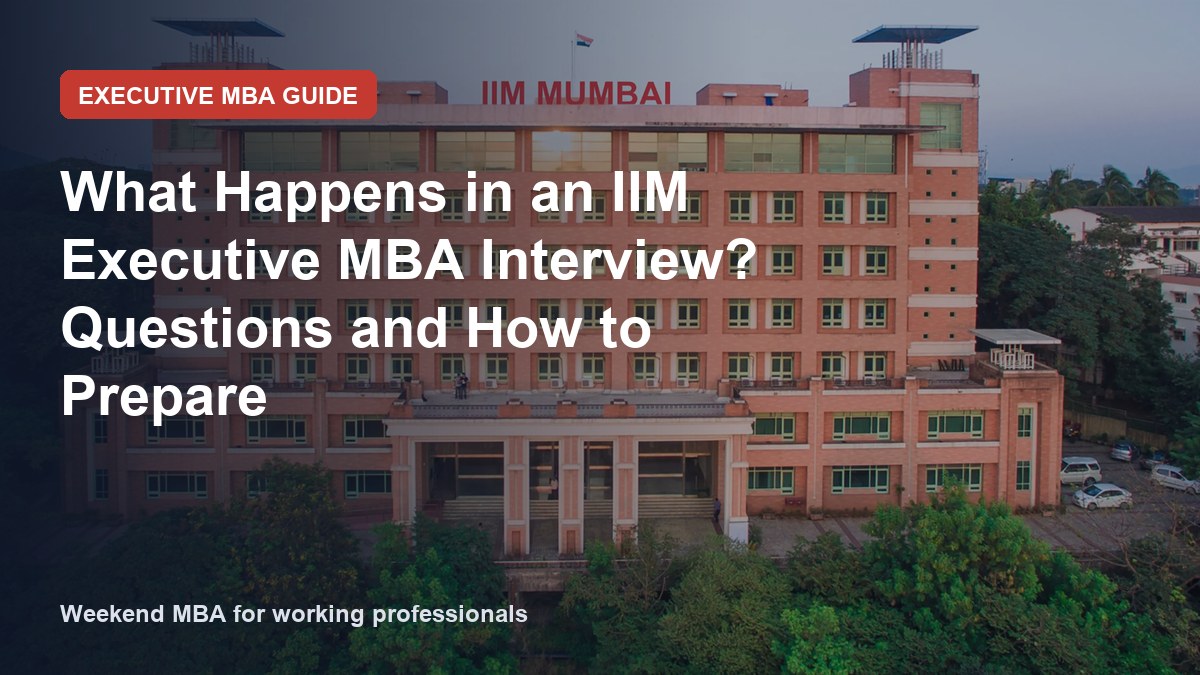
Most candidates for an executive MBA worry more about the interview than the entrance test. That is understandable, because the panel is the one place where your work history, goals and judgement are examined together. This guide covers what shortlisted candidates can reasonably expect, with sample questions and a practical preparation plan.
1. How the interview fits into the selection process
For the IIM Mumbai MBA-PGPM (weekend programme at the Powai campus) and the MBA-ePGPM (same curriculum, live virtual classes at outreach centres), selection works in two steps. First comes the home-proctored IMAT, or a valid CAT (scorecards are issued through iimcat.ac.in), GRE or GMAT score. Then a personal interview is held for shortlisted candidates only.
Dates listed on the official page for the current cycle:
| Step | Date |
|---|---|
| IMAT | 22 November 2026 |
| Personal interview | 25-27 November 2026 |
| Tentative result | 1 December 2026 |
| Secure your seat | 2-11 December 2026 |
| Batch starts | January 2027 |
The official page does not describe the interview format or publish a question list, so treat everything below as general preparation guidance, not insider information.
2. The "walk me through your career" question
Almost every interview opens here. The panel wants a clear story, not a CV recital. Aim for two minutes: where you started, one or two decisions that shaped your path, what you handle today, and where you want to go.
Practise it aloud. Candidates who ramble through ten years of job changes tend to lose the panel early.
3. Why an MBA, and why now?
Expect some version of "You are doing well already, so why an MBA?" A weak answer is "to get promoted" or "for the IIM brand". A stronger one links a specific gap to a specific goal. For example, an operations lead who manages budgets but has never worked on pricing or finance can name that gap and say what they want to be able to do in three years.
Be ready for the follow-up: "What will you do if you complete the MBA and nothing changes at work?" Have an honest answer.
4. Why IIM Mumbai, and why this format?
Do your homework on the programme. Useful, verifiable points include:
- Two years of weekend classes (Saturday and Sunday), so you keep working.
- A 75-credit curriculum with six modules, core subjects in the first year and eight electives in the second.
- Three projects: an Action Learning Project in Year 1 and a two-part Capstone in Year 2.
- IIM Mumbai, formerly NITIE, has a long industrial-management heritage, with strengths in operations, supply chain and analytics.
Link these to your own plans rather than reciting them. If you are choosing a centre outside Mumbai, be ready to explain why the live virtual format suits you.
5. Questions about your current role
Interviewers often go deep on whatever you wrote in the application. Likely probes:
- What is the biggest decision you made in the last year, and what data did you use?
- Tell us about a project that failed. What would you change?
- How many people report to you, and how do you handle underperformance?
- What does your company do to make money, and where does your team fit in?
If you cannot explain your own function's numbers (revenue, cost, margins, turnaround time), fix that before the interview. Pick two or three metrics and know them cold.
6. Can you handle the workload?
This is a practical question that executive MBA panels take seriously. Two years of weekend classes plus assignments, projects and exams is demanding, and the official page notes a minimum 75% attendance requirement. Be ready to discuss:
- Your typical work week and any travel
- Family support and who covers what on weekends
- How you plan to handle quarter-end or deadline pressure at work
A specific plan sounds credible. "I will manage somehow" does not.
7. Funding and commitment
Fees are significant. As listed on the official page, the campus programme is ₹18,00,000 on the annual plan and the outreach-centre programme is ₹14,50,000, inclusive of taxes (verify before applying). Panels may ask whether you have thought through funding, including employer sponsorship or a loan. Having a clear answer signals seriousness.
8. Current affairs and your industry
You are not expected to be a news encyclopaedia. You are expected to follow your own sector: major regulatory changes, competitors, technology shifts. Read two business newspapers or reliable sites regularly for a few weeks before the interview and form opinions you can defend.
9. Your questions for the panel
Prepare two real questions. Ask about the learning approach (the programme uses cases, simulations, industry interactions and capstones) or how weekend schedules are structured, not about things already on the website.
A simple three-week preparation plan
- Week 1: Write your career story, your "why MBA" answer and your goals. Record yourself and trim.
- Week 2: List 8 to 10 work examples (a win, a failure, a conflict, a decision under pressure). Rehearse them in the STAR format: situation, task, action, result.
- Week 3: Do two mock interviews with a senior colleague or friend who will push back. Revise your weak answers.
Key takeaways
- Interviews are held only for shortlisted candidates; dates for this cycle are 25-27 November 2026.
- No official question bank exists, so prepare themes: career story, motivation, role depth, workload, funding.
- Specifics beat generalities. Know your numbers, your goals and the programme structure.
- Honest answers about gaps or failures work better than polished evasions.
FAQ
When are the IIM Mumbai MBA-PGPM interviews held this cycle?
As listed on the official programme page, personal interviews are scheduled for 25-27 November 2026 for shortlisted candidates, after the IMAT on 22 November 2026. Confirm the dates on the official page before you apply.
Is there a fixed list of questions for the executive MBA interview?
No official question bank is published. Interviews usually revolve around your work, your reasons for doing an MBA, your goals and your ability to handle the programme load, so prepare themes rather than scripted answers.
Do I need to mug up case studies or formulas for the interview?
Not as a rule. Expect questions rooted in your own work and industry. It helps to be comfortable explaining the numbers and decisions in your job, and to follow current business news in your sector.
What if I have a career break or a low academic score?
Address it directly and briefly. Explain what happened, what you did next and what has changed since. Panels generally respond better to a clear account than to silence.
Conclusion
A good interview is less about performance and more about clarity: why you want this, why now, and how you will make it work. If your profile fits, start your preparation this week and check the current dates and requirements on the IIM Mumbai executive MBA page. Questions can also go to execed@iimmumbai.ac.in.