
How the IIM Alumni Network Helps Your Career
Quick answer
How an IIM alumni network can support your career: referrals, mentoring, industry insight and credibility. A realistic look, with IIM Mumbai alumni status explained.

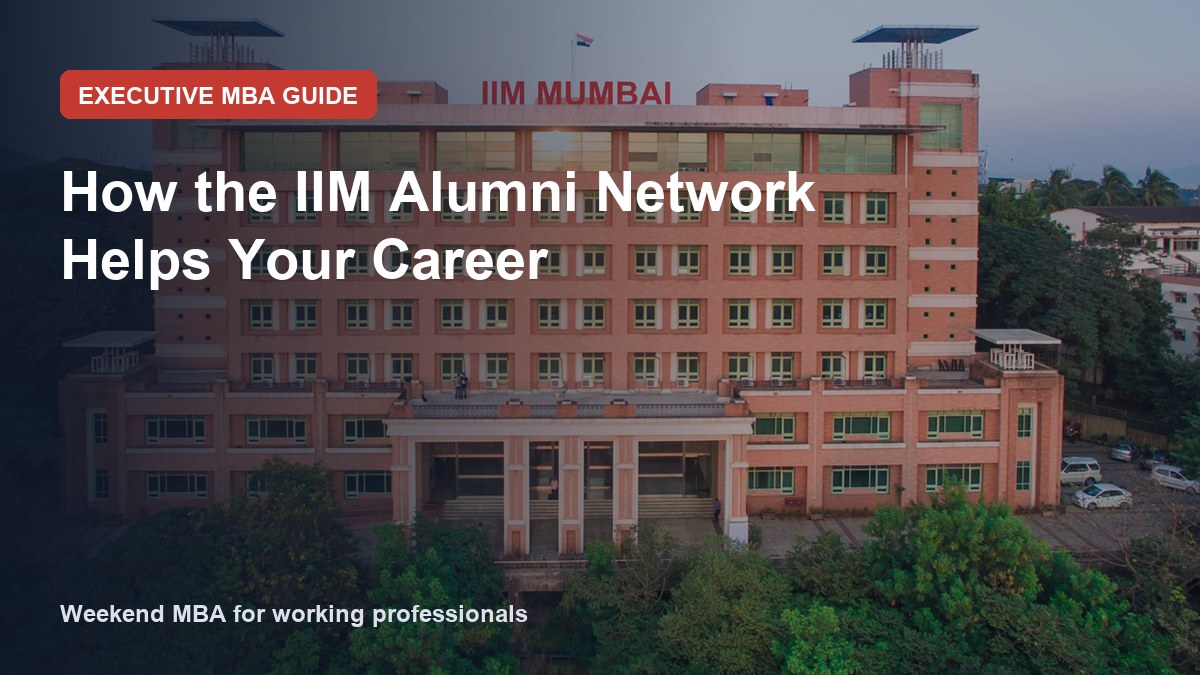
Ask people why they chose an IIM, and the network comes up almost as often as the curriculum. It is also the most overpromised part of any MBA. A realistic view helps: an alumni network is a set of people who are open to a conversation, not a placement guarantee.
Below are seven ways a network of this kind genuinely helps a working professional, plus how to make the most of it. Claims about IIM Mumbai are limited to what its official programme information states.
1. It starts with a shared identity
The MBA-PGPM FAQ states that graduates receive IIM Mumbai alumni status on completion. Campus and outreach-centre students get different certificates (one for the weekend MBA-PGPM and one for the MBA-ePGPM), but the alumni status is part of the offering.
Why does that matter? A shared institute name gives a stranger a reason to reply to your message. It does not guarantee a reply, but it lowers the barrier.
2. It reaches back further than the programme
IIM Mumbai was formerly NITIE, which was established in 1963 and converted into an IIM through the IIM (Amendment) Act, 2023. The brand is new in its IIM form, but the institution has several decades of graduates in industry, particularly in operations, supply chain, analytics and industrial management, which are its recognised strengths. Whether those graduates formally sit in the same alumni structure should be confirmed with the institute, since the official page does not describe the details.
3. Your cohort is your first network
For an executive programme, the most useful contacts are often classmates. Everyone has at least 2 years of relevant work experience and comes from varied sectors. The weekend format, case discussions and group projects mean you see how people think under time pressure. That is more informative than a LinkedIn profile.
Practical tips:
- Rotate your project teammates where you can.
- Offer help on a problem you know well, such as supply chain, finance or tech.
- Stay in touch after modules end, not only when you need something.
4. Mentoring and honest career information
An alumnus who has already made the move you are considering can tell you what the job really involves, what the interview looks like and what they would do differently. This kind of information is usually more valuable than a job posting. Keep requests short and specific, and respect their time.
5. Referrals and introductions
Referrals do happen through alumni connections, but they usually follow a relationship, not a cold request. Someone will refer you when they have seen enough of your work, or trust the person who introduced you. Build credibility first by contributing to discussions, sharing useful material and being reliable on projects.
6. Industry exposure during the programme
The programme's pedagogy includes industry interactions alongside cases, simulations and capstone projects. These are structured opportunities to meet practitioners, and they can turn into long-term professional contacts when you follow up thoughtfully.
7. Credibility with employers and clients
An institute's name acts as a signal when you apply for a role or pitch a project. IIM Mumbai holds the 6th position in the NIRF 2025 management ranking, which gives context when others look up the institute. A signal is only the starting point, though. Your experience and communication decide what happens next.
What to do during the programme to build your network
Alumni networks reward people who start early. A few habits that cost little:
- Introduce yourself properly in the first module, mentioning your role, industry and what you hope to learn.
- Keep a simple list of classmates and faculty you worked with, and note what each person is strong at.
- When you read a useful article or case, share it with someone it could help.
- Attend industry interactions with a question prepared, not just to collect contacts.
- After the programme ends, schedule one or two catch-ups a year. A relationship that is only used when you need a job rarely works.
This applies equally to campus students at Powai and to MBA-ePGPM students at outreach centres in Pune, Chennai, Bengaluru, Hyderabad and Delhi NCR, where you will also meet classmates from your own city, which can be useful for local introductions.
How to use a network without being transactional
| Do | Avoid |
|---|---|
| Send a short, specific message | Sending a generic "please refer me" |
| Share why you are reaching out | Asking for a job in the first message |
| Follow up with thanks and an update | Disappearing after the reply |
| Offer help or insight in return | Treating contacts as a one-way resource |
Key takeaways
- Graduates receive IIM Mumbai alumni status on completion, per the official FAQ.
- An alumni network opens conversations; it does not replace skills or interviews.
- Your classmates are the strongest early network in an executive programme.
- No official alumni headcount or placement statistics are published on the programme page, so treat any such figures with caution.
- Specific, polite requests with something offered in return work best.
Frequently asked questions
Do executive MBA graduates from IIM Mumbai get alumni status?
Yes. According to the official programme FAQ, graduates of the programme receive IIM Mumbai alumni status on completion. Campus (MBA-PGPM) and outreach-centre (MBA-ePGPM) students receive different certificates.
Will the alumni network guarantee me a job?
No network guarantees a job. Alumni connections can open conversations, give you honest information and sometimes provide referrals, but you still have to earn the role through your skills and interviews.
How big is the IIM Mumbai alumni network?
The official programme page does not publish a headcount, so avoid relying on numbers from unofficial sources. What is verifiable is that IIM Mumbai was formerly NITIE, which was established in 1963, so the institution has a long history of graduates.
When should I start networking in an executive MBA?
From the first module. Classmates with at least two years of work experience are your first network, and relationships built through group work and projects tend to last longer than those made at events.
How do I approach an alumnus for advice?
Keep it specific and short. Mention the shared institute, explain what you are exploring, ask one or two precise questions, and offer something useful in return where you can.
Conclusion
The value of an IIM alumni network is real, but it is built, not handed over. If you are weighing programmes, look at the format, the people you will learn alongside and the alumni status on offer. The current IMAT is on 22 November 2026, with the batch starting in January 2027. Details on eligibility and fees are on the IIM Mumbai MBA-PGPM page, and you can email the programme office with questions about alumni access.