
Executive MBA vs Regular MBA: Which Is Right for You After 5 Years of Work?
Quick answer
Executive MBA or full-time MBA after 5 years of work? Compare cost, career break, classmates and entry routes, with IIM Mumbai's weekend MBA as an example.

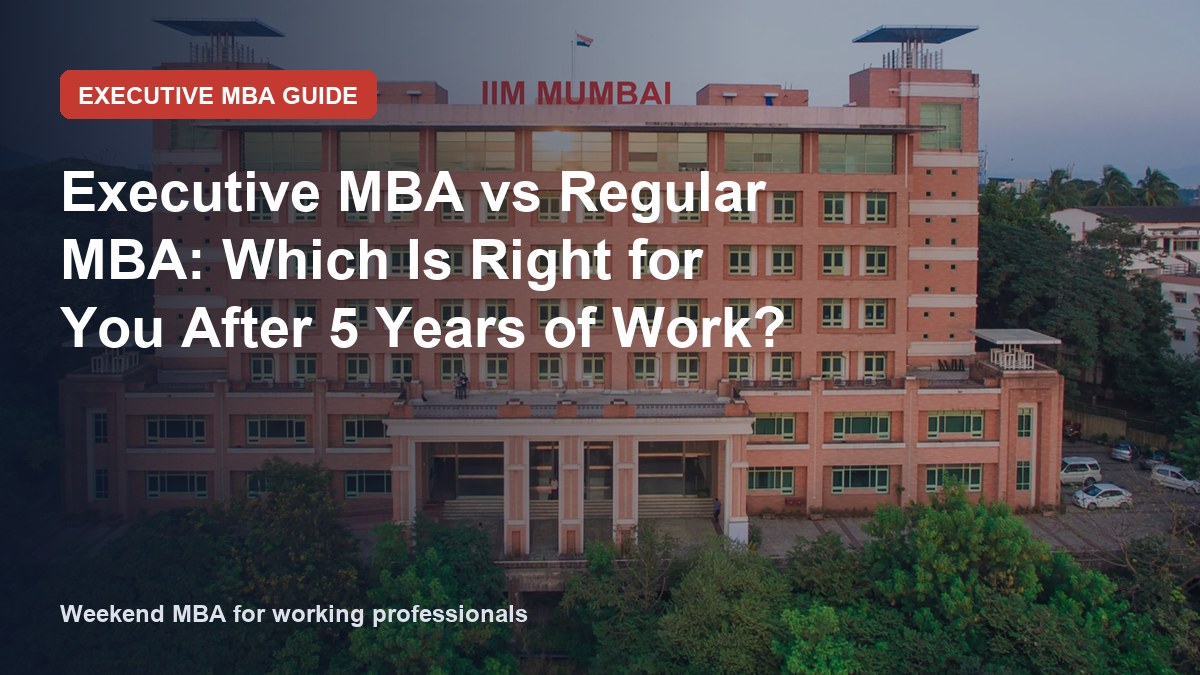
At the five-year mark, most professionals ask the same question: should I leave my job for a full-time MBA, or study while working? Both paths lead to a management qualification, but they differ a lot in cost, risk and who sits next to you in class.
This guide compares them on seven points so you can decide on facts rather than on what your colleagues did.
1. Who the programme is designed for
A regular full-time MBA is usually built around candidates in their early twenties, with a few years of experience at most. Class discussions often start from first principles.
An executive MBA assumes you already manage people, budgets or projects. The discussion starts from your office problems. At IIM Mumbai, for instance, the MBA-PGPM requires a graduation in any discipline plus a minimum of 2 years of relevant post-graduation work experience.
2. The career break
This is the biggest difference. A full-time MBA means stepping out of your job for one to two years, which means no salary, and the gap on your CV has to be explained later. An executive MBA runs on weekends or in blocks, so your income and your seniority keep growing.
If you carry EMIs, support parents or are the main earner at home, the weekend route removes most of that pressure.
There is also a quieter risk with full-time study. Five years in, you may be one promotion away from a bigger role. Leaving at that point can slow the climb, and the market you return to in two years may look different from the one you left. Staying employed keeps that option open while you build new skills.
3. Total cost, not just fees
Compare the full picture:
| Cost item | Full-time MBA | Executive / weekend MBA |
|---|---|---|
| Tuition | Varies by institute | Varies by institute |
| Salary forgone | 1 to 2 years of pay | Usually none |
| Relocation | Often needed | Usually not needed |
| Employer support possible | Rare | More likely |
Sticker prices can mislead. A lower fee with two years of lost salary can cost more than a higher fee while you keep earning. For reference, IIM Mumbai's official page lists the campus MBA-PGPM annual plan at ₹18,00,000 and the MBA-ePGPM outreach annual plan at ₹14,50,000, including taxes. Verify these on the official page before applying, since they can be revised.
4. Entry route
Many full-time flagship MBA programmes at IIMs admit through CAT. Executive programmes usually use their own test or accept other scores. IIM Mumbai's MBA-PGPM accepts the home-proctored IMAT or a valid CAT, GRE or GMAT score, followed by a personal interview. That makes it a practical "IIM without CAT" option for people who have not prepared for CAT in years.
5. Classmates and network
In a full-time batch your peers are mostly freshers-turned-managers a few years later. In an executive batch your peers are already mid-level managers from different industries, so case discussions draw on live experience. For many professionals this peer group is the real value.
6. Learning format
Full-time programmes offer immersion: campus life, clubs, internships. Executive programmes trade that for flexibility. At IIM Mumbai, MBA-PGPM runs on Saturdays and Sundays at the Powai campus. The same curriculum is delivered as the MBA-ePGPM through live interactive virtual classes at outreach centres in Pune, Chennai, Bengaluru, Hyderabad and Delhi NCR. Both run for 2 years.
Expect the load to be real. Weekends go to classes, and weeknights go to assignments. IIM Mumbai's programme also requires minimum 75% attendance.
7. Career outcome you can expect
A full-time MBA is the stronger tool for a complete career switch, such as moving from engineering to investment banking, because recruiters hire on campus. An executive MBA works better for moving up inside your industry, taking a larger role, or shifting functions within the same employer.
No programme can promise a salary jump or a particular role, so be sceptical of any page that quotes one without a source. Ask the institute for verifiable outcome data instead.
Quick decision guide
- Choose an executive MBA if you want to keep earning, grow in your current field and learn with working managers.
- Choose a full-time MBA if you want a clean career switch and can afford the break.
- Choose neither yet if your goal is vague. Spend a month talking to alumni of both.
Key takeaways
- The main trade-off is salary forgone versus immersion.
- Executive MBA classmates are working managers, which changes the quality of discussion.
- Check entry routes: some IIM executive programmes do not require CAT.
- Compare total cost including lost income, not just tuition.
- Confirm the award title and accreditation with the institute before you commit.
FAQ
Is an executive MBA the same as a regular MBA?
Not exactly. Both cover core management subjects, but a regular MBA is built for people with little experience and needs a career break, while an executive MBA runs alongside your job. Check the exact award title of any programme.
Can I do an MBA after 5 years of work experience?
Yes. Many professionals pick a weekend programme at this stage. IIM Mumbai's MBA-PGPM asks for graduation in any discipline and a minimum of 2 years of relevant work experience.
Do I need CAT for an executive MBA at an IIM?
It depends on the programme. For IIM Mumbai's MBA-PGPM, you can take the home-proctored IMAT or submit a valid CAT, GRE or GMAT score, so CAT is not compulsory.
Will an executive MBA make me quit my job?
No. Weekend programmes such as IIM Mumbai's, with Saturday and Sunday classes over 2 years, are designed for people who continue to work.
How do I decide between the two?
Ask whether you can afford a year or two without salary, whether you want a full switch or growth in your line, and what kind of classmates you want. If you are growing in your current line, an executive MBA usually fits better.
Conclusion
After five years of work, the right choice depends less on prestige and more on your finances and your goal. If you want to stay employed and learn alongside managers, a weekend executive MBA is worth serious consideration. The current IIM Mumbai cycle has the IMAT on 22 November 2026 and the batch starting in January 2027. You can read the full eligibility, fee and schedule details on the IIM Mumbai MBA-PGPM page or write to execed@iimmumbai.ac.in with questions before you apply.