
Executive MBA for IT Professionals: Is It Worth Leaving Code?
Quick answer
IT professional weighing an executive MBA? See when it makes sense, what you learn, and how to do it on weekends without leaving your job.

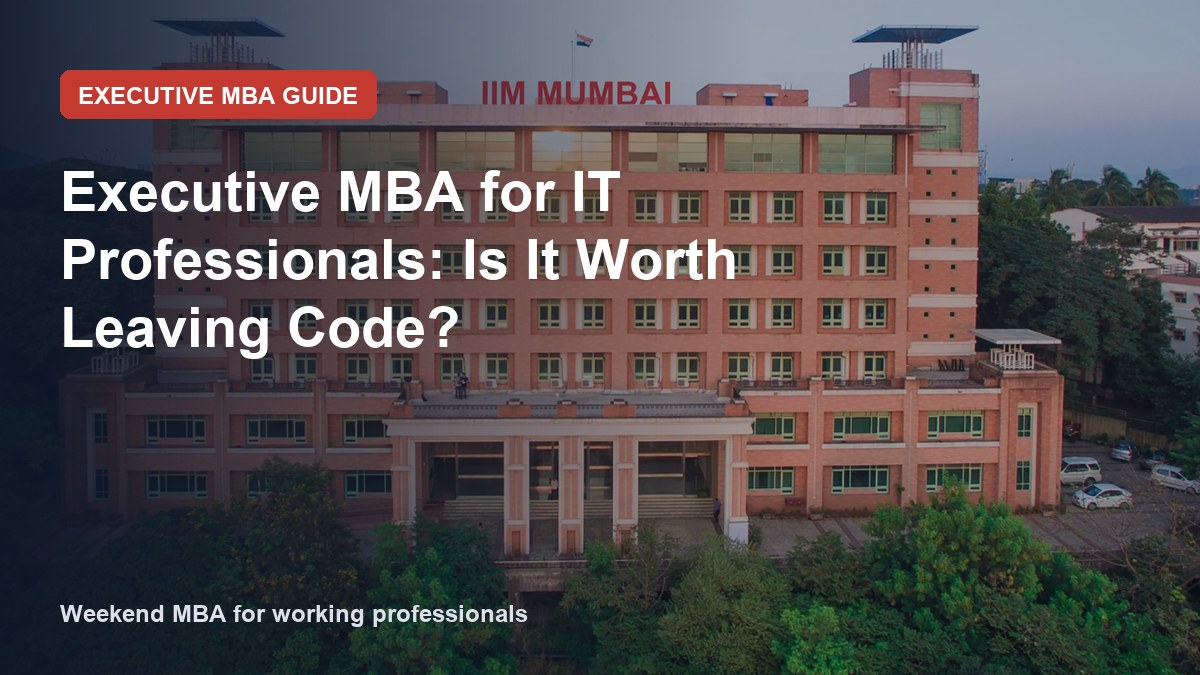
Many software engineers, QA leads and architects reach a point where the next step is no longer about writing better code. It is about running teams, budgets and client relationships. An executive MBA is one route. This post looks at whether it is worth it, and the good news is that "leaving code" is not required.
1. You do not have to quit
The biggest myth is that an MBA means a career break. A weekend format avoids that. The IIM Mumbai MBA-PGPM and MBA-ePGPM run Saturday and Sunday for two years. You continue to earn, keep your seniority and can apply lessons on Monday.
2. Know your reason before you apply
An MBA helps most when the destination is clear. Common reasons among IT professionals:
- Moving from engineering to engineering management or delivery leadership.
- Shifting into product, strategy or business roles.
- Understanding finance and operations to run a P&L.
- Preparing to start something of your own.
If your reason is "everyone is doing it" or "I am bored", pause. Boredom may be solved by a role change rather than a two-year programme.
3. What the curriculum adds to a technical background
Engineers usually know systems well and business mechanics less well. The programme covers 75 credits across 6 modules:
| Area | Examples from the curriculum |
|---|---|
| Finance | Financial Reporting & Accounting, Corporate Finance |
| Markets | Marketing Management, B2B Marketing, Marketing Research & Customer Analytics |
| Operations | Operations Management, Supply Chain Management, Optimisation & Decision Techniques |
| People and strategy | OB & HRM, Strategic Management, Managerial Communication |
| Technology and society | Business Applications of AI & ML, Sustainable Business Management, ESG/Corporate Governance/Ethics |
IIM Mumbai is the former NITIE, known for operations, supply chain and analytics. For someone in IT services or product companies, the operations and analytics strengths can complement a technical base.
4. Where you could end up
Roles that often draw on both technical and business skills include product management, program management, delivery management, business analysis leadership and consulting. No programme can guarantee any of them. The degree of change depends on your experience, your employer, and the market. This post makes no placement or salary claims because none are listed for this programme.
The World Economic Forum's Future of Jobs Report 2025 lists AI and big data among the fastest-growing skill areas, which suggests technical depth will stay valuable. Combining it with business judgement is where an MBA can add something.
5. Staying technical is a legitimate choice
Not every engineer should move to management. If you enjoy hands-on work and your goal is a principal engineer or architect track, deeper technical study or certifications may deliver more. An MBA fits best when you want influence over what gets built and why, not only how.
6. The time budget is real
Software work already has release crunches and on-call weeks. Before applying:
- Check how often your project demands weekend work.
- Remember attendance must be at least 75%. Between 65% and 75% costs one grade, 50% to 65% two grades, and below 50% is an F.
- Plan for assignments, cases and simulations during the week.
- Tell your manager early. Some employers will support or part-fund study. Many will not, so confirm before assuming.
Another practical point is the nature of your employer. Product companies, services firms and GCCs reward different things. In a services firm, delivery and client management skills often drive the next promotion, and finance and operations knowledge helps directly. In a product company, understanding customers, pricing and go-to-market may matter more. Look at the roles one or two levels above yours and ask what they do all day. If the answer is mostly people, planning and budgets, the programme maps well. If it is mostly architecture and code reviews, think again.
7. Check location and format
If you are in Pune, Chennai, Bengaluru, Hyderabad or Delhi NCR, the MBA-ePGPM brings IIM Mumbai's curriculum to your city through live, interactive virtual classes at an outreach centre. If you live in or near Mumbai, the campus MBA-PGPM at Powai is offline. Both are two years and Saturday-Sunday.
8. Costs and admission
As listed on the official page (verify before applying), including taxes:
- MBA-PGPM annual plan: Rs 18,00,000. Module-wise: Rs 19,00,000.
- MBA-ePGPM annual plan: Rs 14,50,000. Module-wise: Rs 15,00,000, plus a refundable caution deposit of Rs 50,000.
Eligibility is a graduate degree in any discipline and at least two years of relevant work experience after graduation. Selection is via the home-proctored IMAT or a valid CAT, GRE or GMAT score, then a personal interview. The application fee is Rs 3,000, non-refundable.
Key takeaways
- A weekend executive MBA lets you keep your IT job.
- It is best for people aiming at leadership, product, delivery or business roles.
- The curriculum combines finance, operations, analytics and AI applications.
- Budget for two years of weekends and 75% attendance.
FAQ
Do I need to leave my IT job to do an executive MBA?
Not for a weekend programme. The IIM Mumbai MBA-PGPM and MBA-ePGPM run on Saturdays and Sundays over two years, so you can keep your job.
Is an MBA worth it for a software engineer?
It depends on your goal. If you want to move into product, program, delivery or business leadership, the business skills can help. If you want to stay deeply technical, a specialised technical course may serve you better.
Can an IT professional get into IIM Mumbai without CAT?
Yes. Applicants can take the home-proctored IMAT or submit a valid CAT, GRE or GMAT score. CAT is not compulsory. A personal interview follows for shortlisted candidates.
Which IIM Mumbai programme suits someone in Bengaluru or Pune?
The MBA-ePGPM runs live, interactive virtual classes at outreach centres in Pune, Chennai, Bengaluru, Hyderabad and Delhi NCR, with the same curriculum as the campus MBA-PGPM.
Does the programme cover AI and analytics?
Module 3 includes Business Applications of AI & ML and Marketing Research & Customer Analytics, and Module 1 includes Optimisation & Decision Techniques.
Conclusion
Leaving code is not the price of an MBA. For IT professionals who want a broader remit, a weekend IIM Mumbai programme can add the business layer without a career break. The current cycle has IMAT on 22 November 2026, interviews on 25 to 27 November and a January 2027 start. Review the full eligibility, fees and refund policy or email execed@iimmumbai.ac.in.