
How to Move from Engineer to Manager in India
Quick answer
Planning a move from engineer to manager in India? Seven practical steps on skills, projects and when a weekend MBA from IIM Mumbai makes sense.

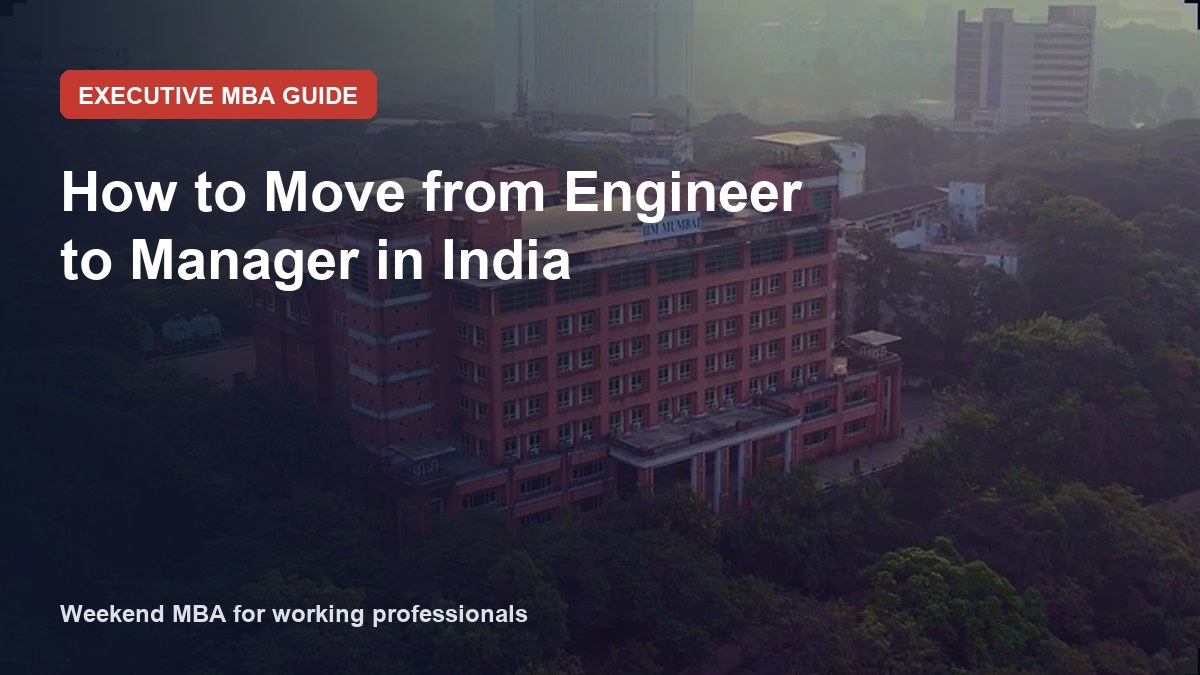
Most engineers hit the same question around year four or five. You are good at the technical work, people ask you for answers, and yet the manager role goes to someone else, or you get it and struggle. The shift from engineer to manager is less about being smarter and more about changing what you are paid to do. Here is a practical path.
1. Understand how the job actually changes
An engineer is rewarded for solving problems. A manager is rewarded for the team solving problems, on time, within budget, with the right priorities. You write less code, hold more conversations and make more trade-offs. If that sounds unappealing, consider the senior technical track instead, which many companies offer. Choose deliberately.
2. Start managing before you are the manager
Do not wait for the title. Volunteer to:
- Lead a small project with deadlines and stakeholders.
- Onboard and mentor new joiners.
- Run sprint planning or release coordination.
- Present updates to non-technical leaders.
These tasks build a record of leading without authority, which promotion committees look for.
3. Learn the language of the business
Engineers often speak features and architecture, while senior leaders speak revenue, cost, risk and customers. Learn how your product makes money, what drives margin and where your team sits in the value chain. Reading your company's annual report or asking finance for a walkthrough is a good start.
4. Fill the skill gaps that engineering does not teach
Typical gaps include:
| Gap | Why it matters |
|---|---|
| Finance and budgeting | You will own cost and justify spend |
| Communication | Alignment with product, sales and leadership |
| People management | Feedback, hiring, conflict, performance |
| Strategy and prioritisation | Saying no to the right things |
| Operations and supply chain thinking | Flow, bottlenecks and delivery |
Short courses, books and mentors can cover some of these. A structured programme covers them together.
5. Get a sponsor, not just a mentor
A mentor gives advice. A sponsor speaks for you when you are not in the room. Find a senior leader who has seen your work and will recommend you for stretch roles. Ask directly what you would need to show to be considered for a team lead position.
6. Decide whether an MBA fits your plan
An MBA is not required, but it can be the right accelerator if you want to move into general management, product or business roles, or strategy. Engineers often benefit from the structured exposure to finance, marketing and strategy.
Working engineers can look at weekend formats. IIM Mumbai's MBA-PGPM is a 2-year weekend programme at the Powai campus. The MBA-ePGPM, often searched as EPGPM, offers the same curriculum through live virtual classes at outreach centres in Pune, Chennai, Bengaluru, Hyderabad and Delhi NCR. IIM Mumbai was formerly NITIE, has over 60 years of history, and is known for operations, supply chain, analytics and industrial management. It is ranked 6 in management in NIRF 2025.
For engineers, relevant courses include Optimisation and Decision Techniques, Operations Management, Business Applications of AI and ML, and Supply Chain Management, alongside Marketing, Corporate Finance, Strategic Management and Innovation and Entrepreneurship. There are 75 credits across 6 modules, with 8 electives and three projects, including a two-part Capstone.
7. Check eligibility, selection and cost
Eligibility is a graduate degree in any discipline plus at least 2 years of relevant post-graduation work experience. Selection is by the home-proctored IMAT or a valid CAT, GRE or GMAT score, followed by an interview if shortlisted. CAT is not compulsory. The application fee is ₹3,000 (non-refundable).
For the current cycle: IMAT on 22 November 2026, personal interviews on 25-27 November, tentative result on 1 December, and a January 2027 batch. The listed annual plan including taxes is ₹18,00,000 for MBA-PGPM and ₹14,50,000 for MBA-ePGPM, with module-wise options on the official page. Verify all details before applying.
Mistakes engineers make on this journey
- Staying the best individual contributor and expecting a promotion automatically.
- Treating management as "more meetings" and avoiding the people side.
- Ignoring finance until it blocks them.
- Choosing a programme by brand alone, without checking schedule and workload.
A 12-month roadmap
- Months 1-3: Ask your manager what the team lead role needs. Take one project with clear ownership.
- Months 4-6: Mentor a junior, present to a non-technical audience and learn how your unit's budget works.
- Months 7-9: Take a course in finance or analytics, or decide on a structured programme and check its dates and eligibility.
- Months 10-12: Review feedback, update your goals and discuss a role change with your sponsor.
This plan works with or without an MBA, and it creates proof of your ability that any selection panel or promotion committee can see.
Key takeaways
- The move is about owning outcomes through others, not only technical skill.
- Start leading small projects and mentoring before you hold the title.
- Learn finance, communication and people management.
- A weekend MBA suits engineers with 2 or more years of experience who want to stay employed.
- IIM Mumbai's programme accepts the IMAT or valid CAT, GRE or GMAT scores.
FAQ
Do I need an MBA to become a manager as an engineer?
No. Many engineers move into management through team lead roles and project ownership. An MBA helps for general management, business roles or strategy where structured training in finance, strategy and people management matters.
How much experience should I have before an executive MBA?
It varies by programme. IIM Mumbai's MBA-PGPM and MBA-ePGPM need a graduate degree in any discipline and at least 2 years of relevant post-graduation work experience.
Can I do an MBA while working as an engineer?
Yes. The MBA-PGPM (campus, Powai) and MBA-ePGPM (live virtual, outreach centres) run on weekends over 2 years.
Is CAT compulsory for IIM Mumbai's executive MBA?
No. You can take the home-proctored IMAT or submit a valid CAT, GRE or GMAT score. Shortlisted candidates attend a personal interview.
What is the first step to become a manager?
Take ownership of outcomes, not just tasks. Lead a small project, mentor a junior, and ask your manager what a team lead role requires.
Conclusion
The jump from engineer to manager is a skill change as much as a title change. Start small, learn the business and choose your formal learning carefully. If a weekend MBA fits your plan, read the MBA-PGPM and MBA-ePGPM page, check the current IMAT date of 22 November 2026, and write to execed@iimmumbai.ac.in with questions.