
ChatGPT Prompts that actually work for marketing professionals in 2026:

Most marketers aren't using ChatGPT wrong because they lack skill. They're using it wrong because they're asking it the wrong kind of question.
Type "write a blog post on AI marketing" into ChatGPT and you'll get exactly what you'd expect: competent, generic, forgettable copy that reads like the thousand other AI-generated posts already sitting on page three of Google. The tool isn't the problem. The prompt is.
In 2026, the marketers pulling ahead aren't the ones with the fanciest AI subscription. They're the ones who've learned to talk to ChatGPT the way you'd brief a sharp new hire with context, a clear role, a defined goal, and constraints that rule out the generic answer before it's even generated. Industry research and case studies keep landing on the same conclusion: structured prompting beats one-line requests, every time, by a wide margin.
This guide walks through 25 ChatGPT prompts for marketing professionals that you can copy, customize, and put to work today across SEO, content strategy, social media, email marketing, competitor research, ad copy, and analytics. No fluff, no theory you can't use by lunchtime.
Why most marketing prompts fail
Before the prompts a quick diagnosis, because understanding why bad prompts fail makes every prompt below click into place.
It's never really ChatGPT's fault. It's the input.
Most marketers hand ChatGPT a request stripped of everything it needs to be useful:
- No audience information
- No business context
- No desired output format
- No conversion goal
- No brand voice guidance
Ask a vague question, get a vague answer. That's not a flaw in the model it's just how language models work. They mirror the specificity (or lack of it) you give them.
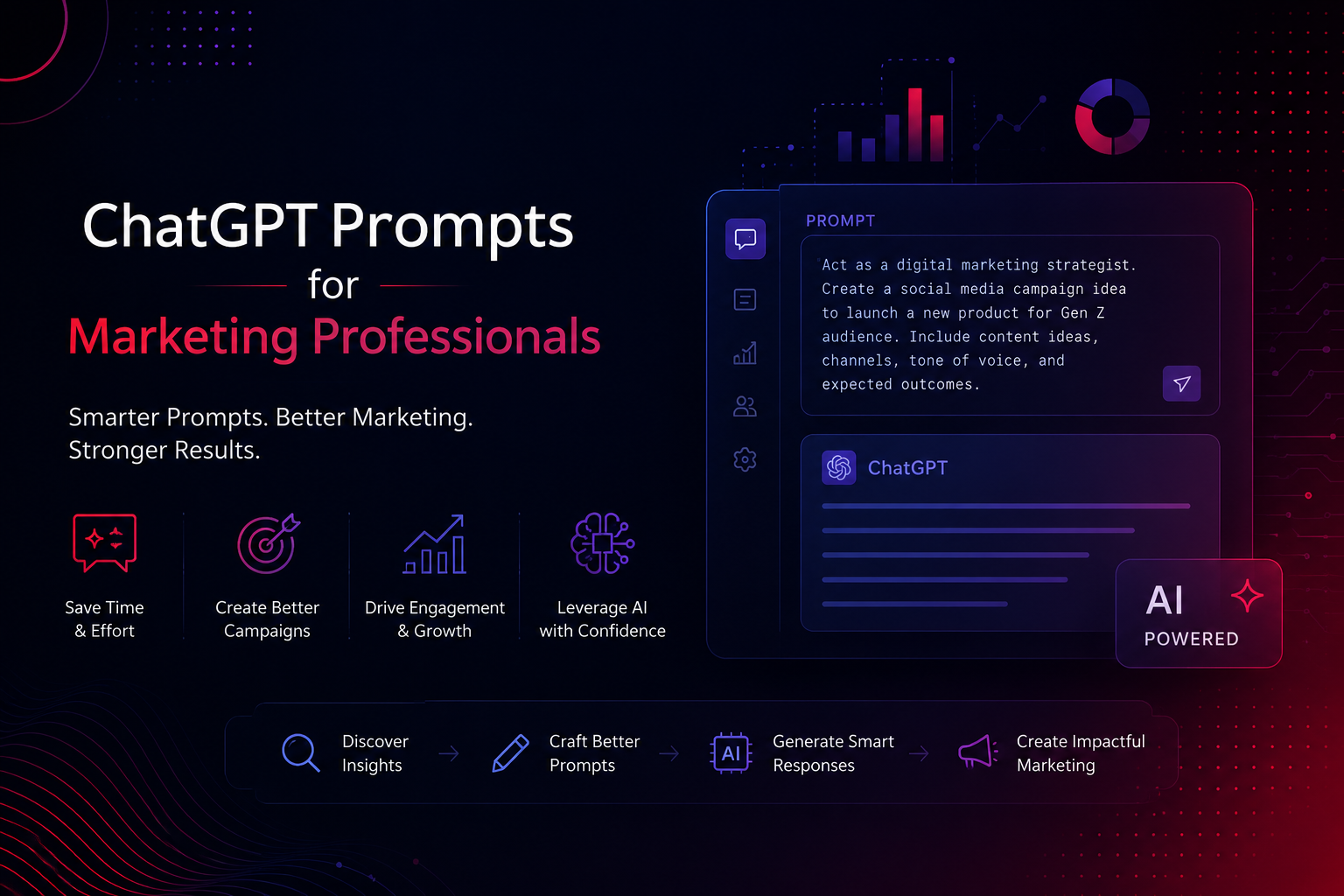
The prompts that consistently perform well share a common structure. They include:
- Context - the situation ChatGPT is operating in
- Role - who ChatGPT should "act as"
- Objective - the outcome you actually want
- Output format - how the response should be structured
- Constraints - what to avoid
- Tone of voice - the voice the output should carry
This approach has a name: structured prompt engineering, and it's quickly becoming one of the most valuable AI skills a marketing professional can have in 2026.
How marketing teams are actually using ChatGPT in 2026
The role of AI inside marketing teams has shifted. It's no longer just the blog post machine. Modern teams lean on ChatGPT across the full funnel:
- SEO research
- Content strategy
- Keyword clustering
- Social media content creation
- Email marketing
- Ad copy generation
- Audience research
- Marketing automation
- Competitor analysis
- Campaign planning
As AI adoption accelerates industry-wide, the most noticeable shift isn't more content, it's less time spent producing it and more time spent on strategy, creative direction, and optimization. The prompts below are built for exactly that shift.
SEO and Content Strategy Prompts
1. ChatGPT Prompt for Keyword Research
SEO keyword ideation is one of the highest-leverage things ChatGPT can do for a marketing team if you give it the right brief.
Prompt:
Act as an SEO strategist. My business is [BUSINESS TYPE]. My target audience is [TARGET AUDIENCE]. Generate:
- 50 keyword ideas
- Group them by search intent
- Categorize as informational, commercial, and transactional
- Highlight low-competition opportunities
- Suggest content ideas for each keyword
Why it works: Instead of spitting out a random list, this prompt forces ChatGPT to reason about search intent and map keywords to actual content opportunities the part most generic keyword prompts skip entirely.
2. ChatGPT Prompt for Blog Content Strategy
Prompt:
Act as a senior content strategist. Create a 3-month SEO content plan for a [NICHE] business. Include:
- High-intent keywords
- Blog topics
- Search intent
- Funnel stage
- Estimated content difficulty
- Internal linking opportunities Prioritize traffic and lead generation.
Why it works: This gives you a content roadmap, not a scattered list of blog ideas with no relationship to each other or to your funnel.
3. ChatGPT Prompt for SEO Content Briefs
Prompt:
Create a detailed SEO content brief for the keyword: "[PRIMARY KEYWORD]" Include:
- Search intent
- Target audience
- Competitor analysis
- Recommended H2s
- Related keywords
- Questions users ask
- Internal linking opportunities
- Suggested CTA
Why it works: Strong content briefs are the difference between a writer guessing at what good looks like and a writer executing against a clear target. This prompt builds that brief for you in seconds.
Social Media Marketing Prompts
4. ChatGPT Prompt for Social Media Marketing
Prompt:
Act as a social media strategist. Create a 30-day content calendar for [BRAND]. Include:
- LinkedIn posts
- Instagram content
- Reels ideas
- Hooks
- CTAs
- Engagement questions Target audience: [AUDIENCE]. Goal: [AWARENESS / LEADS / SALES].
Why it works: It produces channel-specific content rather than one generic post awkwardly repurposed three times each platform gets content built for how people actually use it.
5. ChatGPT Prompt for LinkedIn Growth
Prompt:
Act as a LinkedIn growth consultant. Create 10 LinkedIn post ideas about [TOPIC]. Each post should include:
- A strong hook
- Storytelling angle
- Key insight
- CTA
- Engagement question Target professionals in [INDUSTRY].
Why it works: LinkedIn rewards posts that blend genuine expertise with personal narrative. This prompt structure nudges ChatGPT toward that mix instead of dry, corporate-sounding updates.
Email Marketing Prompts
6. ChatGPT Prompt for Email Marketing
Prompt:
Create a 5-email nurture sequence for [PRODUCT]. Include:
- Subject lines
- Preview text
- Email body
- CTA
- Objection handling Goal: Convert leads into customers.
Why it works: A single email rarely converts cold leads. Sequences need progression each email building on the last and this prompt asks ChatGPT to think in those terms from the start.
Competitor and Market Research Prompts
7. ChatGPT Prompt for Competitor Analysis
Prompt:
Act as a market research analyst. Analyze the top competitors in [INDUSTRY]. Provide:
- Positioning strategy
- Key messaging
- Content themes
- SEO opportunities
- Gaps they are not addressing Recommend opportunities for differentiation.
Why it works: Competitive analysis often surfaces the content gaps and positioning angles you didn't know you were missing this prompt pushes ChatGPT past surface-level summary and into actual strategic recommendations.
Ad Copy and Performance Marketing Prompts
8. ChatGPT Prompt for Ad Copy Creation
Prompt:
Act as a performance marketer. Create:
- 10 Google Ads headlines
- 5 Meta ad variations
- 5 CTA options Target audience: [AUDIENCE]. Main benefit: [BENEFIT]. Use persuasive but non-clickbait language.
Why it works: It's anchored to conversion, not just creative copy for its own sake and the non-clickbait constraint keeps the output usable on platforms that penalize hype.
Marketing Analytics Prompts
9. ChatGPT Prompt for Marketing Analytics
Prompt:
Act as a marketing analyst. Review the following campaign data: [PASTE DATA] Identify:
- Top-performing channels
- Underperforming campaigns
- Optimization opportunities
- Budget recommendations
- Next steps Present findings in table format.
Why it works: This turns ChatGPT into a decision-support tool rather than just a writing assistant useful when you need a fast first pass on campaign data before a strategy meeting.
The Prompt formula that consistently produces better results
After analyzing hundreds of high-performing prompts, the same underlying structure keeps showing up. Every prompt above and every prompt you write going forward should answer six questions:
Once this framework becomes second nature, you stop trying prompts and start engineering outputs.
Common mistakes marketers make when using ChatGPT
Even with good prompts in hand, a few habits quietly undercut results. Watch for these:
- Using one-line prompts
- Not specifying audience
- Not defining goals
- Publishing AI content without editing
- Ignoring SEO intent
- Forgetting brand voice
- Using AI without human review
The most successful marketers treat ChatGPT as a collaborator that accelerates the work never as a replacement for strategy or judgment.
The Future of AI-Powered Marketing
AI is reshaping marketing workflows content creation, campaign management, search visibility, all of it. But here's the part most people miss: the marketers who gain the biggest edge won't necessarily be the ones with access to the best tools.
They'll be the ones who know how to ask better questions.
Prompt engineering is fast becoming a core marketing skill, simply because output quality tracks input quality so closely. As AI-driven search, content generation, and automation keep evolving, the marketers who've mastered prompting will be the ones positioned to actually move the numbers.
Conclusion
ChatGPT has outgrown its early reputation as a content-writing shortcut. Used well, it's a genuine marketing co-pilot across SEO, content, social, email, and growth strategy alike.
The goal was never to automate marketing entirely. It's to strip out the repetitive work so marketers can spend their time where it actually matters: strategy, creativity, and decision-making.
In 2026, the marketers who win won't be the ones using AI the most.
They'll be the ones using it the smartest.
Also Read
What Skills Actually Get You Hired in Tech in 2026?