
Best entrepreneurship program in India for first-time founders (2026)

Every year, a huge number of people in India get a genuine idea for a startup. A much smaller number ever launch it. And an even smaller number find a cofounder who sticks, build something people are willing to pay for, and walk into a room with investors who actually take them seriously. The distance between "I have an idea" and "I have a company" is where most people quietly give up and it's rarely because the idea itself was weak.
It usually comes down to three things: no cofounder to build with, no structure to move fast, and no real access to the people who write the first cheque. That gap is exactly what a new breed of founder programs is now built to close not a course you watch on weekends, but a condensed, in-person-and-online sprint that takes you from a blank page to a live pitch in front of venture capital partners, in eight weeks.
India has more startups than ever, and there is still a huge founder problem
The numbers make the opportunity obvious. India now has well over 2.4 lakh DPIIT-recognised startups, making it the world's third-largest startup ecosystem, with FY26 alone adding over 55,000 new recognitions the highest annual jump on record. Deep tech, AI-native products, fintech and D2C brands are pulling in fresh capital again after a slow patch, and the government's newly expanded Fund of Funds 2.0, worth roughly ₹10,000 crore, is specifically aimed at getting early-stage capital moving faster.
But scale hasn't fixed the founder problem. Despite this growth, India still accounts for under 5% of global startup funding while holding nearly a fifth of the world's population a gap that says the pipeline of investable, well-built early-stage companies is still too thin. And the startups that do get built often don't survive long enough to matter: recent data shows over 11,000 Indian startups shut down in a single year, close to 30-40 closures a day, with cofounder mismatches, weak go-to-market execution and running out of cash showing up again and again as the actual causes not bad ideas.
What actually separates founders who make it from those who don't
Look closely at why early startups fail and a pattern shows up fast. It's rarely the product concept. It's the absence of a few unglamorous things: a cofounder who was chosen well instead of chosen fast, a first version that ships in weeks instead of months, a go-to-market motion that gets tested with real users instead of assumed, and eventually a shot at the right investor conversation instead of a hundred cold emails into the void.
Compare this with how the world's most consistent founder factories operate. Accelerator-style programs that compress company-building into a matter of weeks, force teams to form early, and end with a real investor room have produced a disproportionate share of the breakout companies in India's startup ecosystem. The format works because it removes the three things that quietly kill most first attempts: isolation, indecision, and the absence of a deadline that actually matters.
That's the exact problem a new 8-week, invite-only entrepreneurship program has been built to solve and it's worth understanding in detail, because the structure is genuinely different from the usual startup bootcamp.
Inside the 8-week program: from a blank page to a pitch in Bangalore
The format is simple to describe: three days in Goa to find a cofounder and a problem worth building, five weeks online actually building and shipping the product, and two closing weeks in Bangalore ending with a live pitch to real venture capital partners. Only 100 seats run per cohort, applications are read individually rather than filtered by an algorithm, and every week carries the same rhythm five days of open building time, a Saturday masterclass taught by a founder who has actually raised capital and built a company, and a Sunday session with a domain expert who reviews what got shipped that week.
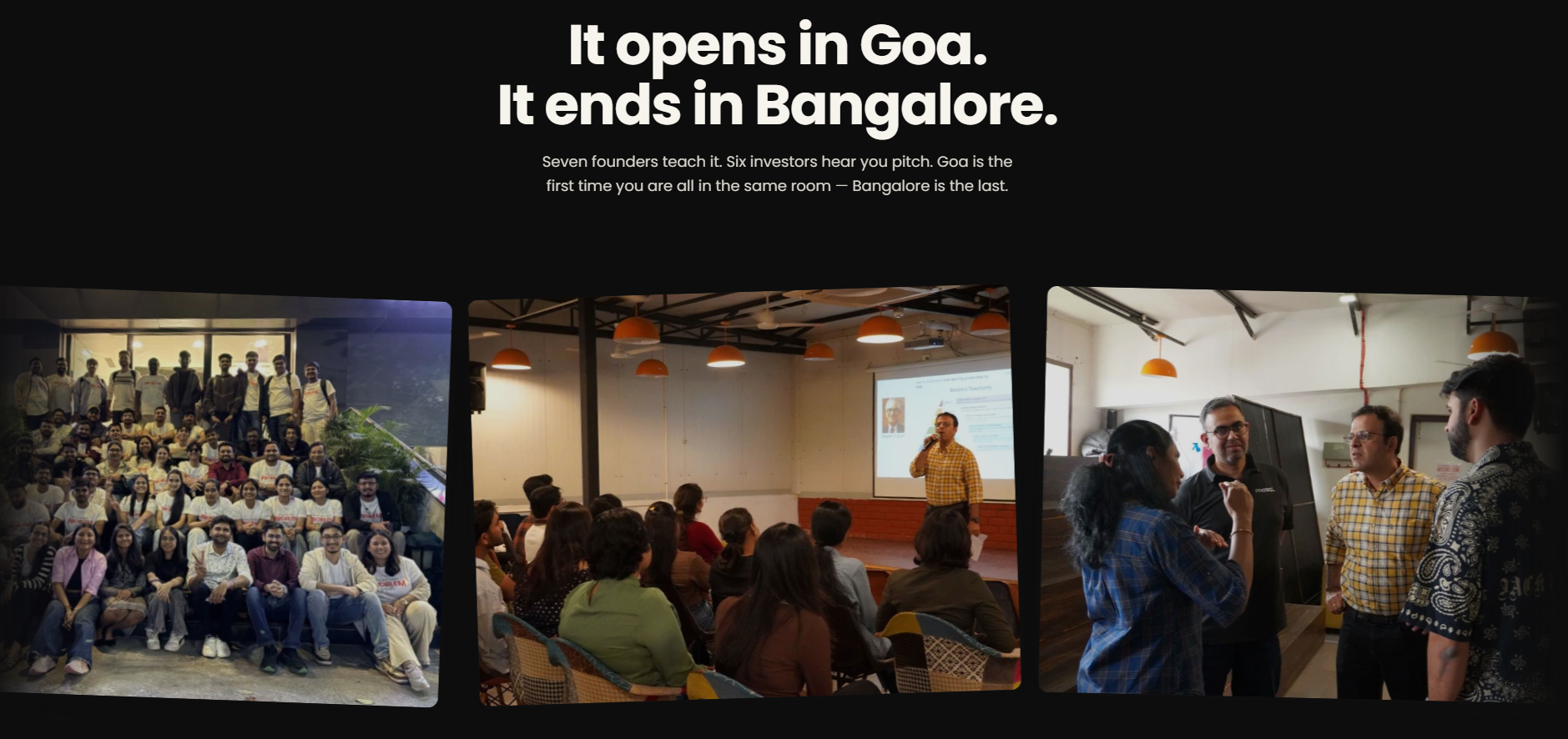
Here's how the eight weeks actually break down:
- Week 1 - Goa: Three days on the coast with the other 99 builders in the cohort, built around finding the right cofounder and validating a problem worth spending eight weeks on.
- Week 2 - Build: The idea turns into a working MVP, built almost entirely with AI tools Cursor, Claude Code and similar and reviewed by a real founder on the weekend call.
- Week 3 - Grow: Picking one go-to-market channel, one core message, and getting the first 100 users through it, using AI-assisted content and outreach tools.
- Week 4 - Grow: Turning a pipeline of leads into an actual paying customer, with a session dedicated to handling objections and closing calls.
- Week 5 - Grow: Becoming numbers-literate as a founder cohort retention, the KPIs investors actually look at, and separating real growth from vanity metrics.
- Week 6 - Run: The unglamorous but essential part: first hires, managing burn and runway, and building just enough process without slowing the team down.
- Week 7 - Bangalore: The cohort lands in person and stops building to size the round, sharpen the story, and get pressure-tested by the people teaching that week.
- Week 8 - Demo Day: The pitch, delivered in the same room as partners from active venture funds, no warm introduction required to get the meeting.
The people teaching aren't professors. Every Saturday masterclass is taught by a founder who has actually built and raised for a company, and the cohort gets a different one almost every week across the eight. Every founder in the program also gets two bookable 30-minute one-on-one slots each week with a domain expert, on top of the group sessions, so the feedback isn't limited to a weekly call.
Demo Day itself is the part most programs can't credibly promise: founders pitch directly to partners from three active funds in one room in Bangalore, with no requirement of a warm introduction to get there. The program doesn't take equity or a revenue share of any kind the fee covers the seat, and whatever gets built stays entirely the founders' own.
On cost, there are three ways in, and the price drops the more of a team applies together: a solo founder seat is priced at ₹1,50,000, a founding pair works out to ₹1,12,500 per founder, and a full three-person founding team brings the cost down to ₹1,00,000 per founder which also solves the cofounder problem directly, since Week 1 in Goa is explicitly built around helping solo applicants find the right person to build with.
Getting in follows five simple steps: pay a ₹999 fee to unlock the application form, fill it out with your background and (if you have one) your idea, record a two-minute pitch in one take with no slides, wait for a decision based on the form and the pitch together, and if selected, pay the program fee to confirm your seat. Every seat includes the Goa kickoff, the full eight weeks of masterclasses and expert sessions, the two weekly one-on-one expert slots, and access to Demo Day in Bangalore.
Who this is actually built for
This isn't aimed at someone who wants to "learn about entrepreneurship" in the abstract. It's built for people who are close to building something real and are missing one specific piece a cofounder, the discipline to ship in weeks instead of months, or a credible shot at an investor conversation. That includes early-career professionals sitting on a business idea they've never had the structure to test, technical folks who can build but have never had to sell, and non-technical founders who now have AI tools to build with but still need the muscle of shipping fast and pitching well. It's less useful for someone who already has a funded, growing company this is squarely a first-time-founder, zero-to-one program.
Frequently Asked Questions
Can I apply without a cofounder or even a fixed idea? Yes applying solo is common, and Week 1 in Goa is deliberately built around this. Three days are spent finding the right person to build with and validating a problem worth the next seven weeks, so you don't need to walk in with either piece fully figured out.
Is this a full-time commitment for eight weeks? The fixed weekly commitments are light on paper one Saturday masterclass, one Sunday expert session, and two 30-minute one-on-one slots but the building itself, which is where most of the actual time goes, is scheduled around you rather than in fixed class hours, except for the in-person weeks in Goa and Bangalore.
Do I need a technical background to build a product in five weeks? No. The build weeks are explicitly structured around AI-assisted development tools like Cursor and Claude Code do a large share of the technical heavy lifting, with the expectation that founders review and direct the build rather than write every line themselves.
Does the program take equity in return for the seat? No. There's no equity, revenue share, or other claim on what gets built. The cost is a one-time program fee, and founders keep full ownership of their company.
Is getting funded guaranteed at the end of eight weeks? No program can honestly promise that, and this one doesn't. What it does guarantee is the pitch itself a real, in-person meeting with partners from active venture funds on Demo Day, with the funding decision entirely theirs to make.
How is this different from just applying to Y Combinator or a similar accelerator? The format borrows from the same accelerator logic compressed timelines, forced momentum, a real investor deadline but is built specifically around India's early-stage founder journey, including in-person time in Goa and Bangalore and a fee structure that doesn't require giving up equity to participate.
When does applying actually pay off financially? Since cost is split per founder, applying with a cofounder already in place brings meaningful savings; a three-person founding team pays ₹1,00,000 per founder against ₹1,50,000 for a solo applicant while a solo seat remains the right call for anyone still looking to find their cofounder inside the cohort.