
7 reasons why working professionals are choosing IIT Jodhpur's MBA Technology over traditional MBAs in 2026

For decades, the MBA was the most reliable signal a professional could send.
It said: I understand business. I can lead. I'm serious about growth.
That logic still holds. The MBA hasn't lost its value. What's changed is the environment in which business decisions get made and by extension, what a genuinely useful MBA needs to prepare you for.
Artificial Intelligence is inside strategic decisions, not just IT departments. Data is influencing everything from product roadmaps to supply chain calls to customer acquisition. Digital transformation is no longer a change management project it's the operating context every manager now works in.
As a result, many professionals in 2026 are asking a different question. Not "should I pursue an MBA?" but "what kind of MBA will actually prepare me for where business is going?"
That's one of the central reasons IIT Jodhpur's MBA Technology, a 2-year, executive-format postgraduate programme from the School of Management and Entrepreneurship at IIT Jodhpur is attracting serious interest from working professionals.
Here's what makes it different, what it actually costs, what you'll learn, and whether it's the right call for where you are in your career.
Why traditional MBAs are being re evaluated
Traditional MBA programmes remain valuable. Finance, marketing, operations, strategy, and leadership these are not going away.
What's changing is that none of these functions now operate independently of technology.
The WEF Future of Jobs Report 2025 identifies analytical thinking, AI literacy, and technological understanding as among the fastest-growing skills employers are prioritising globally. McKinsey's State of AI 2025 report found that 78% of organizations are now using AI in at least one business function, up from 55% two years ago.
The practical implication: business leaders are increasingly expected to evaluate AI opportunities, interpret data-driven insights, lead digital transformation initiatives, and make informed calls in technology-enabled environments.
That's not a technical skill set. It's a management skill set for a world where technology is the context, not the subject.
And that's precisely the gap that MBA programmes with a technology focus are designed to close.
What is the IIT Jodhpur MBA Technology?
The MBA Technology is a postgraduate management degree from IIT Jodhpur's School of Management and Entrepreneurship. It is a 66-credit, 4-semester programme delivered in an executive-friendly hybrid format live online sessions with IIT Jodhpur faculty, combined with structured on-campus immersions.
It is not a distance learning programme. It is not a certificate course. It is a full MBA, awarded by IIT Jodhpur, with the same academic weight and alumni status as any other degree from the institute.
The programme is designed specifically for working professionals people who want to continue building their careers while earning a postgraduate management credential from one of India's most respected technical institutions.
Programme at a glance:
1. Technology is no longer optional for business leaders
The most significant shift in modern management over the last five years isn't a new framework or leadership model. It's the fact that technology has moved from a back-office function to a board level decision variable.
Today's managers are regularly expected to weigh in on:
- How AI can improve business performance in their function
- What digital transformation actually means for their team or organisation
- How to interpret analytics outputs and act on them
- What the competitive implications of emerging technologies are
- How to work effectively with technical teams who think differently
You don't need to become a software engineer. But you do need to understand how technology influences business outcomes well enough to lead in an environment where it does every day.
As Prof. Avinash Kumar Agarwal, Director of IIT Jodhpur, notes about the programme: "The professionals who will lead the next decade are those who can move fluently between technical understanding and strategic judgment who see these not as different skills, but as two dimensions of the same capability."
That's the core argument for MBA Technology. And in 2026, it's a hard one to argue against.
2. A curriculum built around the intersection
The IIT Jodhpur MBA Technology is structured across two years foundations first, depth and specialisation second.
Year 1 Core business and technology foundations
The first year builds a rigorous grounding in management essentials while developing the analytical and organisational capabilities specific to technology-driven business environments.
Courses include: Business Statistics, Corporate Finance, Fundamentals of Marketing, Digital Enterprise Management, Operations Management, Strategic Management, Business Economics and Macroenvironment, Human Behaviour and Organization Dynamics, New Venture Planning, and Fundamentals in Accounting.
The focus: analytical decision-making, business acumen, and strategic thinking as applied to modern digital enterprises.
Year 2 Advanced technologies and specialisation
The second year moves into applied AI, analytics, and digital innovation with industry-integrated learning and a work-integrated capstone project.
Courses include: Artificial Intelligence in Business, Legal and Taxation Aspects of Business, Work-Integrated Project, and a full specialisation pathway.
3. Two specialization pathways and both matter
One of the most practically important features of this programme that often gets overlooked: you don't choose a generic MBA track. You specialise. And the two tracks reflect where actual demand is concentrating in 2026.
Analytics and AI
Designed for professionals who want to lead in data-intensive and AI-driven business environments.
Specialisation courses: Business Storytelling with Data Visualisation and ML, Supply Chain Analytics, Deep Learning Applications for Business, HR Technology & Talent Analytics, Big Data & Cloud Computing, Human-AI Collaboration at Work, Business Process Analytics, and Technology Forecasting and Assessment.
Best for: professionals in operations, finance, strategy, or consulting who want deep capability in AI and analytics as a business leadership tool.
Digital product management
Designed for professionals who want to lead digital products, customer-facing technology, and go-to-market strategy.
Specialisation courses: Creating Digital Products and Services, Digital Marketing Analytics & Optimisation, Digital Business Models, Consumer Behaviour, Design Thinking and Innovation Strategy, Marketing Research and Analysis, Go-to-Market Strategies, and Market Structure and Strategy.
Best for: professionals in product, marketing, growth, or business development who want to lead digital product strategy and innovation.
The choice between these two tracks should be driven by where you see yourself creating value over the next five to ten years not which sounds more impressive.
4. Built specifically for working professionals
One of the most consistent barriers to postgraduate education for mid-career professionals is simple: stepping away from work for two years isn't practical.
The IIT Jodhpur MBA Technology is designed explicitly around that constraint.
How the format actually works:
- Live online sessions weekly, led by IIT Jodhpur faculty; built for real dialogue, case discussions, and peer learning not recorded lectures you watch alone
- Campus immersions 2 per academic year, 5-7 days each, at IIT Jodhpur; includes workshops, peer collaboration, faculty interaction, and networking within the IIT ecosystem
- Work-integrated project your capstone is designed to connect directly to your professional context, not a generic case study
This means you continue earning while studying. You apply concepts immediately in your actual work. And you build a professional network of cohort peers, faculty, IIT alumni that compounds over time.
5. The IIT Jodhpur credential what it actually means
When evaluating management programmes, institutional credibility is not a soft consideration. It directly affects how the credential reads on a resume, how recruiters weight it, and what doors it opens over the course of a career.
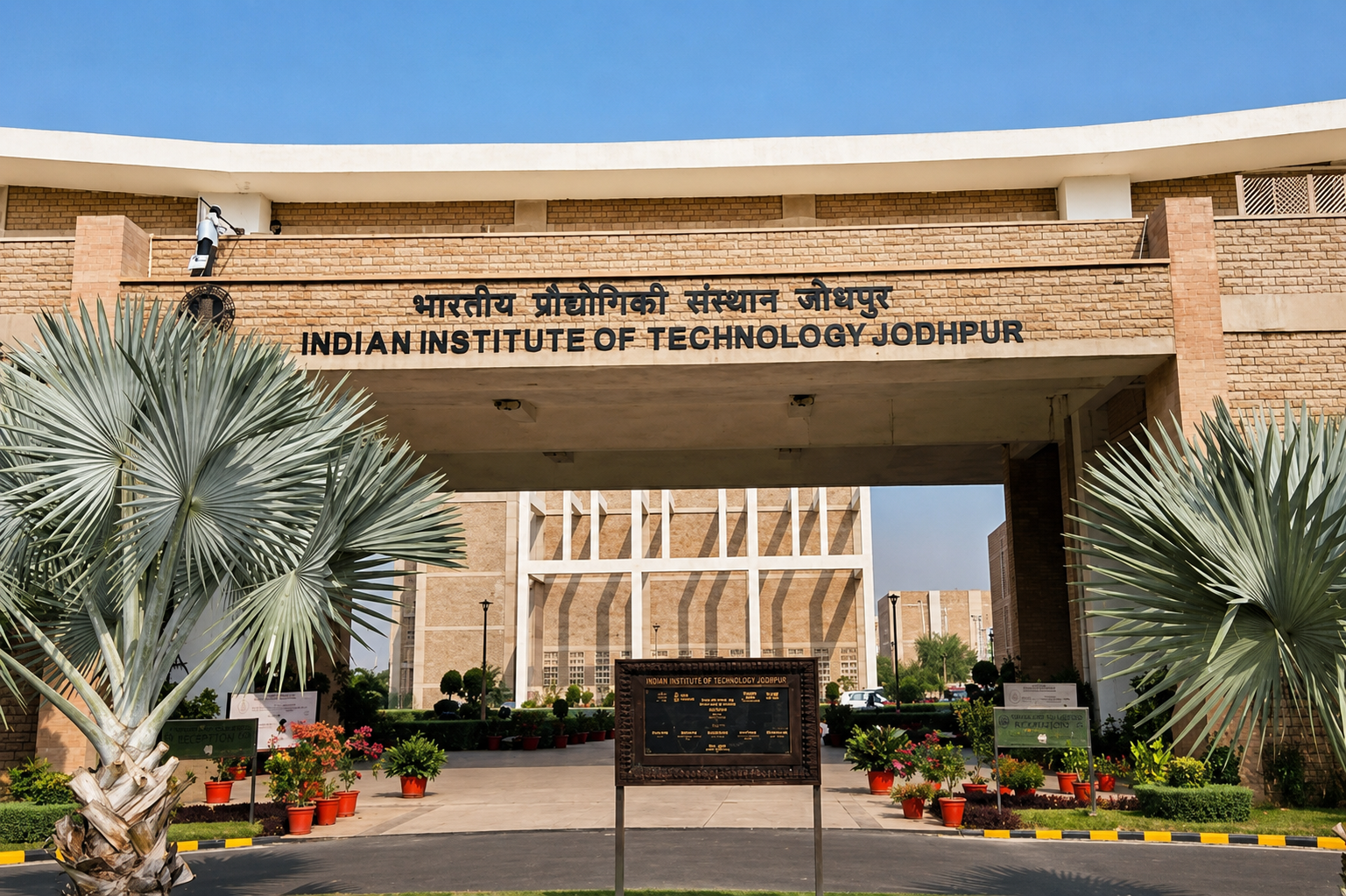
IIT Jodhpur was established in 2008 as one of India's next-generation IITs. Its School of Management and Entrepreneurship is led by faculty who combine management research expertise with deep engagement in technology and innovation which is precisely what this programme draws on.
Graduates of the MBA Technology receive:
- A full MBA degree awarded by IIT Jodhpur
- IIT Jodhpur alumni status recognized by the official alumni association
- Access to the IIT alumni network across India and globally
- A physical degree certificate from IIT Jodhpur
This is not a co-branded certificate or a partnership credential. It is a degree from IIT Jodhpur.
As Anuj Pal Kapoor, Associate Dean of Executive Education at IIT Jodhpur, notes: "Leadership at the intersection of technology and business is one of the most consequential challenges of our time. The MBA Technology is designed for professionals who are ready to meet it."
6. Career paths where this degree creates direct value
The honest question every professional asks before committing to a postgraduate programme: what career opportunities does this actually create?
The MBA Technology is directly relevant to a set of roles that are among the fastest-growing and highest-compensating in India's 2026 job market roles that sit precisely at the intersection of business understanding and technology fluency:
- Product Manager ₹12-22 LPA at growth-stage and product companies
- Business Analyst (AI-focused) ₹12-25 LPA
- Technology Consultant ₹18-25 LPA at top consulting firms
- Digital Transformation Manager ₹15-22 LPA
- Analytics Manager ₹20-35 LPA
- Strategy Consultant ₹18-28 LPA
- AI Product Manager ₹12-35 LPA (fastest-growing PM specialisation in 2026)
These aren't roles that require a purely technical background. They require exactly what this programme develops: business judgment, technology literacy, data fluency, and the ability to communicate across functions.
7. Admission process, fees and key dates
Eligibility:
- 3-year or 4-year undergraduate degree from a recognised institution
- Minimum 60% aggregate marks in undergraduate degree
- At least 2 years of relevant work experience
Entrance test format:
- 60 MCQs, 120 minutes
- 3 sections: Logical Reasoning (20 Q), Verbal Ability (20 Q), Numerical Ability (20 Q)
- Conducted online; no advanced mathematics required
- Negative marking applies
Admission steps:
- Pay ₹999 entrance test fee + complete the online application
- Appear for the entrance test on 12th July 2026
- Results declared 13th July 2026
- Attend counselling and pay ₹5,000 seat booking amount (non-refundable)
- Receive provisional admission offer; pay Year 1 fee within 20 days
- Programme begins 1st August 2026
Fee structure:
Refund policy:
- 100% refund before classes begin
- 50% refund within 1 month of programme commencement
- No refund after 1 month of commencement
Traditional MBA vs MBA Technology: An honest comparison
Who should seriously consider this programme?
MBA Technology is not for everyone. It's specifically built for:
- Working professionals with 2+ years of experience who want a postgraduate management credential without a career break
- Engineers and technical professionals looking to move into leadership, strategy, or product roles
- Business analysts and operations managers who want to deepen their AI and analytics capability
- Product and marketing professionals who want the strategic depth of an MBA alongside digital product specialisation
- Consultants who want IIT level academic credibility behind their client-facing work
- Entrepreneurs building technology driven businesses who want structured management and strategic thinking frameworks
The common thread: professionals who recognise that the gap between business and technology is closing and who want to be positioned on the right side of that convergence.
Frequently asked questions
Q: Is the IIT Jodhpur MBA Technology equivalent to a full time on campus MBA from IIT Jodhpur? Yes. The programme holds the same academic value, credits, and recognition as a regular on-campus degree, delivered in an executive hybrid format. Graduates receive a full MBA degree from IIT Jodhpur, not a diploma or certificate.
Q: Is the campus immersion mandatory? The programme includes 2 campus immersions per academic year (5-7 days each). One immersion per year is mandatory. Exceptions for the second immersion may be granted in genuine cases such as medical emergencies, with approval from the programme directors.
Q: Can I apply if I don't have a technical background? Yes. The programme is open to graduates from any discipline engineering, commerce, arts, sciences. The entrance test assesses logical reasoning, verbal ability, and numerical aptitude not domain-specific technical knowledge.
Q: What is the entrance test format? 60 MCQs across 120 minutes 20 questions each in Logical Reasoning, Verbal Ability, and Numerical Ability. Conducted online. No advanced mathematics. Negative marking applies.
Q: What specialisation should I choose Analytics & AI or Digital Product Management? This depends on where you want to create value over the next decade. Analytics & AI is the stronger track if you work in operations, finance, strategy, or consulting and want deep data and AI capability. Digital Product Management is the stronger track if you work in product, marketing, or growth and want to lead digital products and go-to-market strategy.
Q: What is the refund policy if I need to withdraw? 100% refund before classes begin. 50% refund within the first month of classes. No refund after 1 month of commencement. The ₹999 entrance test fee and ₹5,000 seat booking amount are non-refundable under all circumstances.