
1-Year vs 2-Year Executive MBA in India: Pros and Cons
Quick answer
One-year full-time or two-year weekend executive MBA? Compare income loss, depth, entry rules and fit for working professionals in India.

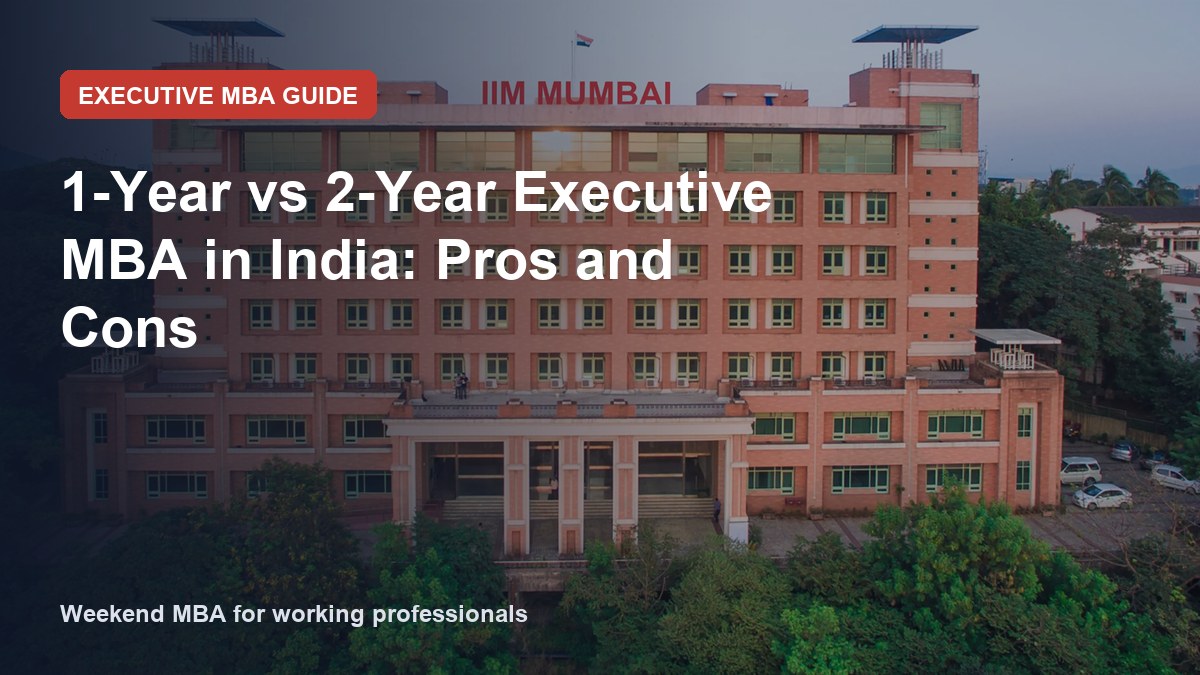
"Faster must be better" is the most common assumption when working professionals compare executive MBA options. It is not always true. A one-year full-time programme and a two-year weekend programme solve different problems, and the wrong pick can cost lakhs in lost income or leave you stretched thin for two years. Here are the real trade-offs.
1. What the two models look like
One-year executive MBAs in India are generally full-time and residential. For example, IIM Ahmedabad describes its PGPX as a one-year, full-time, residential programme. You step out of work for the duration.
Two-year executive MBAs are generally part-time, with classes on weekends. IIM Mumbai's MBA-PGPM runs on Saturdays and Sundays for two years at the Powai campus. The MBA-ePGPM follows the same curriculum through live virtual classes at outreach centres in Pune, Chennai, Bengaluru, Hyderabad and Delhi NCR.
2. Income and career continuity
This is usually the deciding factor.
- 1-year full-time: You give up a year of salary, bonus and possibly promotion cycles. Some employers grant sabbaticals or study leave, but many do not.
- 2-year weekend: You keep earning and stay visible at work. The cost is personal time, not income.
For a mid-level professional with EMIs, school fees or dependants, continuing salary often settles the question. Do the arithmetic with your own figures: one year of take-home pay plus lost increments, against the extra year of weekends.
3. Depth and pace
A one-year programme compresses coursework, so the pace is intense, but you are fully immersed. A two-year programme gives more time to absorb and apply.
IIM Mumbai's programme is a 75-credit curriculum across six modules, with 17 core courses, 8 electives in the second year, an Action Learning Project in Year 1 and a two-part Capstone in Year 2. Spreading this over two years lets you test ideas at work between modules. For example, you can use what you learn in Corporate Finance or Supply Chain Management in the same quarter as your real budget review.
4. Networking and immersion
Full-time residential programmes build tight cohorts because you live and study together every day. Weekend programmes build different ties: classmates tend to be working peers from varied industries, and the network keeps growing for two years as projects and electives mix groups.
Neither is automatically stronger. Think about which kind of network you will actually use.
5. Entry requirements
Eligibility differs a lot, and it matters more than the duration.
- IIM Ahmedabad's PGPX page lists a bachelor's degree, a minimum of four years of full-time work experience and a valid GMAT or GRE score.
- IIM Bangalore's EPGP page lists a valid GMAT or GRE score, and its FAQ says CAT is not considered.
- IIM Mumbai's MBA-PGPM/ePGPM asks for a graduate degree in any discipline and at least two years of relevant post-graduation work experience. Selection is via the home-proctored IMAT or a valid CAT, GRE or GMAT score, followed by a personal interview for shortlisted candidates. CAT is not compulsory.
Rules change by cycle, so confirm on each official page before you plan. If you have no GMAT or GRE and do not want to prepare for one, the choice may be made for you.
6. Cost: fee versus total cost
Do not compare fees in isolation. Total cost = programme fee + lost income + travel or relocation + opportunity cost.
IIM Mumbai's official page lists these fees inclusive of taxes (verify before applying):
- Campus programme: ₹18,00,000 on the annual plan, or ₹19,00,000 module-wise.
- Outreach-centre programme: ₹14,50,000 annual, or ₹15,00,000 module-wise, plus a refundable ₹50,000 caution deposit.
For one-year programmes, check the fee on that institute's own brochure and add a year of foregone salary. For weekend programmes, the fee is spread over two years and your salary continues.
7. Employer support
Sponsoring a weekend programme is easier for most companies because the employee remains at work. A one-year break needs a leave arrangement or a bond, and the employer may prefer to hire your replacement permanently. If sponsorship matters, a weekend format is usually the easier conversation.
8. Which one fits whom
Pick a one-year full-time programme if:
- You want a full reset, such as a change of industry or function.
- You can afford a year without income.
- You meet the experience and GMAT/GRE rules.
Pick a two-year weekend programme if:
- You want to move up within your field or company.
- You cannot or do not want to pause earning.
- You prefer to apply learning at work as you go.
Key takeaways
- One-year programmes are generally full-time and residential; two-year programmes like IIM Mumbai's are weekend-based.
- The biggest hidden cost of a one-year MBA is the lost year of income.
- Entry rules differ widely: IMAT or CAT/GRE/GMAT at IIM Mumbai, GMAT/GRE at some one-year IIM programmes.
- Choose based on your goal (switch vs advance), finances and discipline.
FAQ
Is a 1-year executive MBA easier than a 2-year one?
Not easier. A one-year full-time programme compresses the same ground into fewer months and usually needs a career break. A two-year weekend programme spreads the load but runs alongside a full-time job.
Do I have to quit my job for a 2-year executive MBA?
No. IIM Mumbai's MBA-PGPM and MBA-ePGPM are two-year Saturday-Sunday programmes designed for people who keep working.
How many years of experience do 1-year executive programmes expect?
It varies by institute and year. IIM Ahmedabad's one-year PGPX lists four years of full-time experience on its programme page, while IIM Mumbai's weekend programme asks for a minimum of two years. Always check the current official eligibility.
Which is cheaper, 1-year or 2-year?
Compare total cost, not the fee alone. A one-year programme adds the cost of lost salary during the break, while a weekend programme lets you keep earning. Check each institute's official fee page.
Conclusion
Duration is a proxy for a bigger question: do you want to pause your career or push it forward? If you prefer to keep earning and apply lessons as you learn, read the full structure and dates for the IIM Mumbai weekend MBA programmes. The IMAT for this cycle is on 22 November 2026 and the batch starts in January 2027.